Luxury motor yachts, catamarans, expedition ships and dive liveaboards: what each class does best, where it falls short, and how to choose. Picked by local experts who have sailed the islands 40+ times.
Tap what matters to you, slide to your party size, and tick up to three classes to compare side by side. Ratings are our relative, experience-based view across the best boats in each class, not official scores.
Up to 16 guests
Luxury motor yachts
The classic Galapagos experience: one naturalist, one shore group, quick pangas and a quiet deck at anchor.
Stability
Intimacy
Deck & lounge space
Cabin choice
Best for & watch-outs
Best for: Couples, photographers and small groups who want the islands to feel personal.
Watch-out: More roll than a catamaran or big ship on open crossings; ask where the cabin sits.
Usually up to 16 guests
Catamarans
Two hulls, a wide beam and big open decks. Steadier at anchor than a monohull of the same size.
Stability
Intimacy
Deck & lounge space
Cabin choice
Best for & watch-outs
Best for: Families, friends and motion-wary travelers who still want a small-boat feel.
Watch-out: Layouts vary widely; compare cabin size and deck plan, not the label.
Roughly 40–100 guests
Expedition ships
The steadiest ride in open water, larger dining rooms, lectures, more cabin categories and, on some ships, elevators and private balconies.
Stability
Intimacy
Deck & lounge space
Cabin choice
Best for & watch-outs
Best for: Easily seasick travelers, seniors, families who want space, and anyone who likes onboard amenities.
Watch-out: Guests split into several guide groups ashore; the feel is less intimate.
Small specialist boats
Diving liveaboards
Built for certified divers. Remote northern dive sites such as Darwin and Wolf are reached by liveaboard.
Stability
Intimacy
Deck & lounge space
Cabin choice
Best for & watch-outs
Best for: Experienced divers chasing big pelagic life; operators typically ask for advanced certification and logged dives.
Watch-out: Not a naturalist land-visit cruise; few or no shore landings.
No class matches every filter. Clear one, or ask us directly.
Side-by-side
02 / SIZE IN PERSPECTIVE
Small by world standards, on purpose.
Galapagos cruise ships are tiny compared with ocean liners. Park rules cap vessels at 100 guests, and most boats carry 16 or fewer. That is why landings feel quiet and why choosing the right class matters.
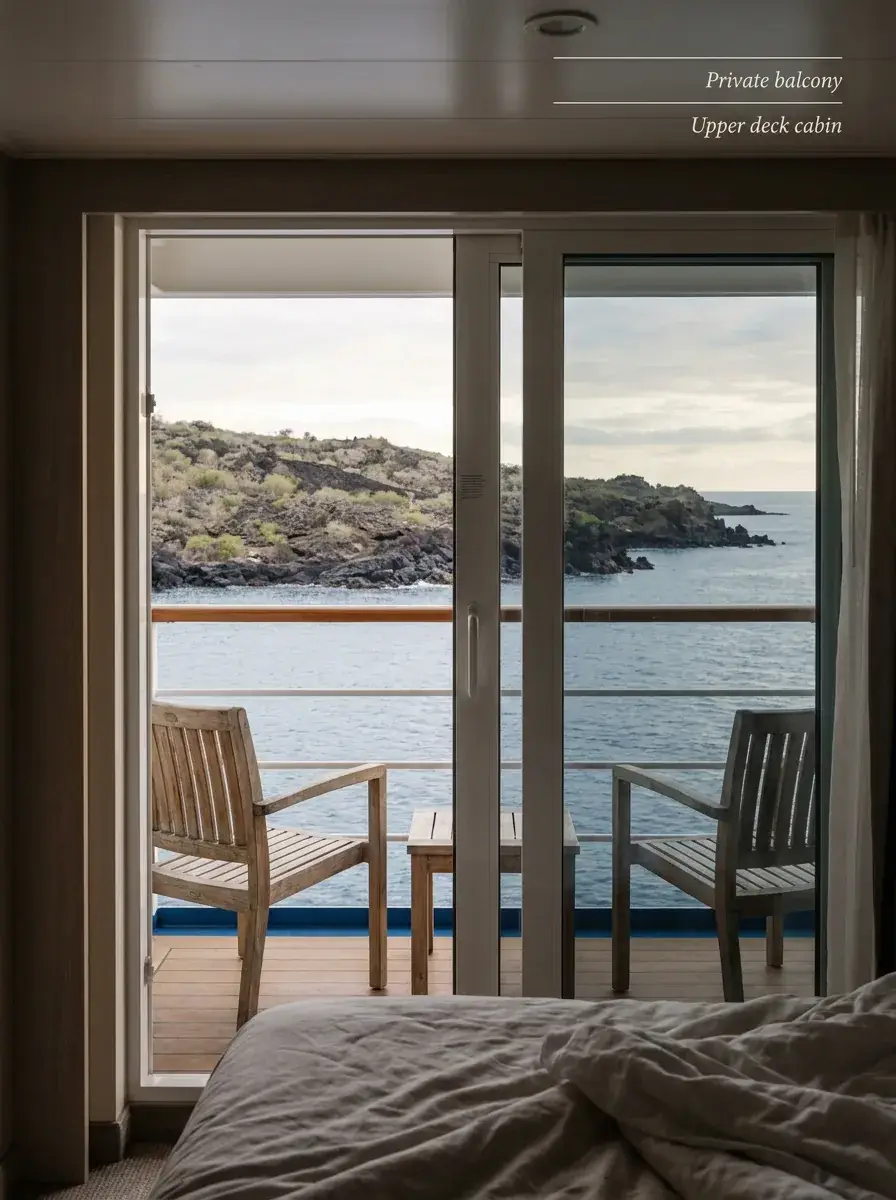
Found only on some vessels and categories, mostly larger and newer ones. A balcony changes how you spend time between landings, not what you see ashore. Balcony vs panoramic window · Is a balcony worth it?
The ship is your floating base; the itinerary decides the wildlife. Swipe through sites travelers ask us about most, then match a ship whose route includes them on your dates. Sightings are never guaranteed.
We have been to Galapagos more than 40 times and know every boat’s strengths and weaknesses. We work only with the best ships and yachts that meet every one of your requirements, and we explain how to check that each vessel’s operator and owner deliver what they promise.
Permits in order. A valid park operating permit and an authorized itinerary for your dates.
Operator and owner checked. The company on your contract really operates the boat, and the owner stands behind it.
Maintenance and safety. Equipment, upkeep and an honest motion profile for your route.
Guides and crew. Licensed naturalists who teach well, and a crew that cares.
Cabin reality. The deck plan, beds and noise match the brochure.
The right price. Itemized, current and in writing: park fee, TCT, flights and tips spelled out.
There is no single best ship, only the best fit. Small luxury yachts and catamarans (up to 16 guests) suit travelers who want intimacy; expedition ships (roughly 40–100 guests) suit those who want stability and space. We shortlist only top vessels whose itinerary, cabins and motion profile match your group. Use the cruise finder.
How big are Galapagos cruise ships?
Small. Park rules cap vessels at 100 guests, and most yachts and catamarans carry 16 or fewer. A few small ships carry around 20, and expedition ships typically carry roughly 40 to 100.
Which Galapagos cruise ships are the most stable?
Larger expedition ships roll the least in open water, and catamarans are steadier at anchor than monohull yachts of a similar size. A low, midship cabin moves least on any boat. Seasickness on a Galapagos cruise.
Do all Galapagos cruise ships visit the same islands?
No. The park assigns approved itineraries to each vessel, so routes differ by boat and date. Compare the day-by-day visitor sites, then the ship. Best itinerary for a first trip.
Do Galapagos cruise ships have balconies?
Some do, mostly on larger and newer vessels and only in certain cabin categories. Many small yachts offer panoramic windows instead. Private balcony vs panoramic window.
Can I scuba dive from a regular Galapagos cruise?
Scuba in the Galapagos runs on specially permitted dive liveaboards and land-based dive centers for certified divers. Naturalist cruises focus on guided snorkeling and landings. Tell us your certification level and we will match the right option.
NEXT STEP
Tell us who is traveling. We will match the ship.
Email hola@galapagosislands.cruises with your month, group and must-haves. You get two to four vetted ships with honest pros and cons and the right price, in writing.