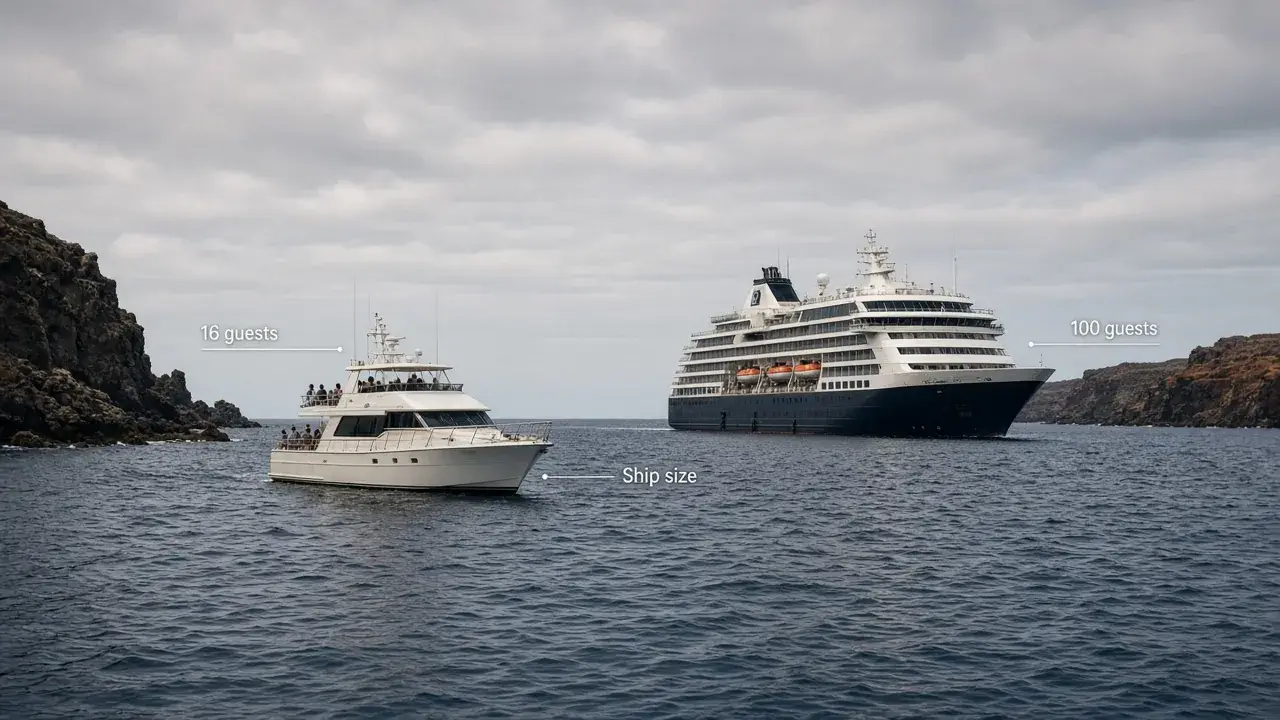
A 16-passenger yacht usually means fewer guests at briefings, smaller shore groups, and a tighter social circle. A 100-passenger ship usually means more public space, more cabin variety, and larger logistics at landings. The real 16 passenger vs 100 passenger Galapagos cruise decision is how you want the day to feel—privacy and pace versus facilities and social energy—not a wildlife guarantee. Traveling as a family or group of friends? Galapagos charters let you choose the route, the timing and who is on board.
16 passenger vs 100 passenger Galapagos cruise: what is the quick answer?
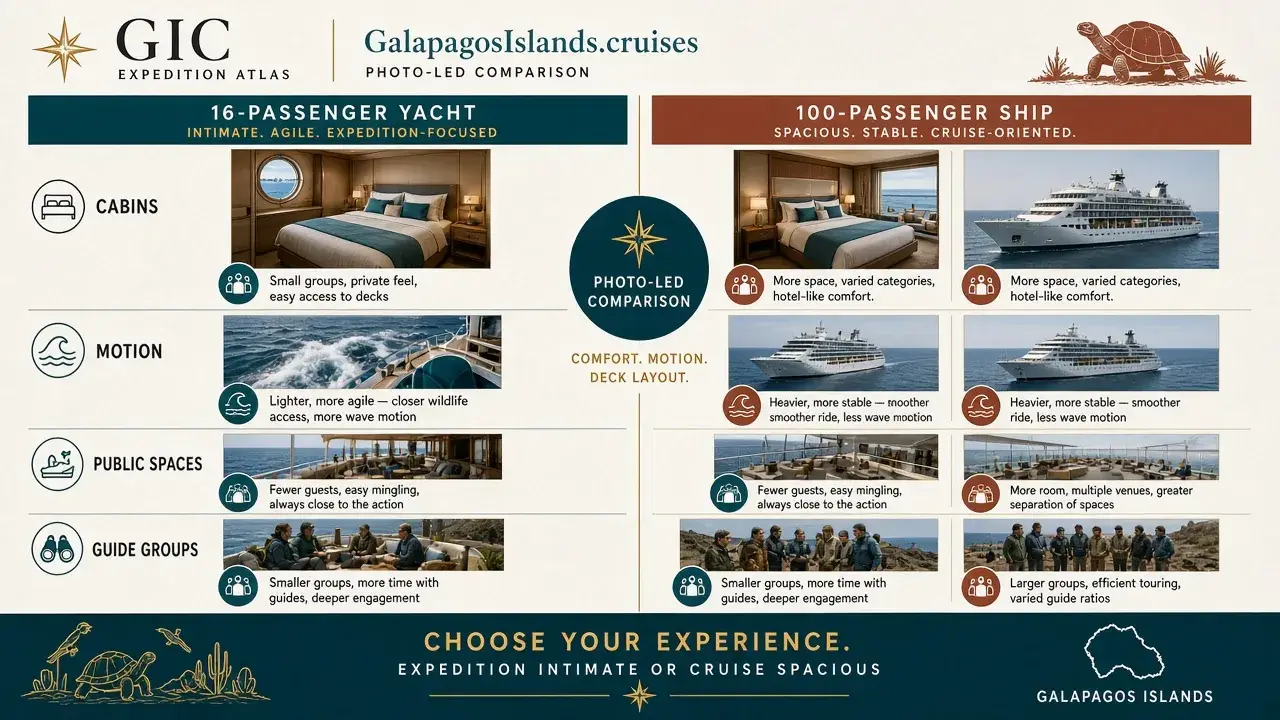
Quick answer: pick the 16-passenger side of a 16 passenger vs 100 passenger Galapagos cruise comparison when you want intimate naturalist briefings, quick panga loading, and a yacht-scale rhythm. Pick the 100-passenger side when you value wider decks, more dining and lounge options, and a broader mix of cabin categories—accepting that shore groups and public spaces will feel larger.
That is the practical core of any serious 16 passenger vs 100 passenger Galapagos cruise shortlist. In the Galápagos, both vessel classes run on park-permitted itineraries with licensed naturalists and crew. Ship size changes onboard density, cabin logistics, and how landings are staged—not whether park rules apply. Treat the 16 passenger vs 100 passenger Galapagos cruise question as an experience-design choice inside the same regulatory system.
Use this rule of thumb
- Prefer ~16 guests when cabin adjacency, quiet evenings, and small shore cohorts matter most in a 16 passenger vs 100 passenger Galapagos cruise trade-off.
- Prefer ~100 guests when motion comfort, elevator access, or suite variety outweigh intimacy on your 16 passenger vs 100 passenger Galapagos cruise shortlist.
- Always read the deck plan and shore-group practice before you fall in love with a brochure photo.
If you are comparing hulls, start with the Galápagos cruise ships overview, then filter dates in the cruise Finder. For trip-length context, see our 5-day vs 8-day Galapagos cruise guide.
What changes in the real onboard experience?
Beyond passenger count, a thoughtful 16 passenger vs 100 passenger Galapagos cruise comparison looks at how daily life actually unfolds between breakfast and the evening briefing.
Briefings, dining, and social density
On a yacht sized for roughly sixteen guests, dinner conversation often includes most of the passenger list. Briefings feel like a field camp. On a ship closer to one hundred guests, you will meet more people—and you may also share dining rooms, lounges, and lecture spaces with larger groups. Neither model is “better” in absolute terms; they solve different social preferences in a 16 passenger vs 100 passenger Galapagos cruise shortlist. If you want the same faces every evening, the yacht end of the spectrum usually fits. If you enjoy a larger community and more space to retreat, the bigger ship can feel easier.
Shore logistics and panga rhythm
Landings still follow visitor-site rules. What changes is staging: how many pangas launch, how long boarding takes, and how large each walking group feels. Smaller vessels often move fewer boats with a tighter cadence. Larger vessels typically split guests into multiple shore groups with assigned guides. Ask how many guests typically walk together—those answers matter more than brochure adjectives when you weigh a 16 passenger vs 100 passenger Galapagos cruise decision.
Noise, privacy, and evening energy
Intimate yachts can feel quiet after dinner—or lively if your particular group is social. Larger ships offer more places to spread out: additional lounges, wider decks, and sometimes later activity options depending on the vessel’s house rhythm. If sleep quality or early mornings matter, ask about cabin location relative to engines, generators, and public spaces on both ends of any 16 passenger vs 100 passenger Galapagos cruise spectrum.
Activity windows and optional add-ons
Snorkel outings, glass-bottom rides, and kayak slots (when offered) are still constrained by the day’s visitor-site plan. Larger vessels may have more equipment and staggered groups; smaller yachts may feel more synchronized because almost everyone shares the same window. Confirm what is included versus optional, and whether activity groups are split by ability—especially if mixed fitness levels are traveling together on that sailing week.
Browse Galápagos cruises when you want vessel classes and route families side by side before you lock a size preference.
How do comfort, motion and layout affect different travelers?
Comfort, motion, and layout are where a 16 passenger vs 100 passenger Galapagos cruise choice becomes personal—especially for first-timers, multi-generation parties, and anyone sensitive to sea conditions.
Motion and hull feel
Larger expedition ships often feel steadier in open water for many travelers, though conditions, routing, and individual sensitivity still matter. Smaller yachts can feel more “close to the water,” which some guests love and others find tiring on longer overnight passages. There is no universal winner: ask about typical overnight crossings on the specific itinerary letter, not only about passenger capacity. Motion comfort is a traveler fit issue inside any 16 passenger vs 100 passenger Galapagos cruise comparison.
Cabin size, bathrooms, and storage
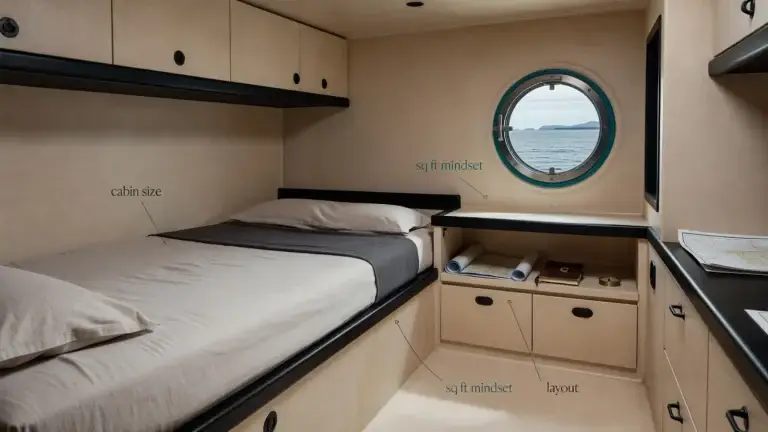
Sixteen-guest yachts sometimes trade suite square footage for intimacy; one-hundred-guest ships often publish a wider ladder of cabin categories. Count usable storage, bathroom layout, and whether twins convert to doubles. Families should confirm whether adjoining or nearby cabins exist. Singles should ask how single supplements or shared-cabin policies work on each vessel type. Layout beats raw passenger count when you unpack for a week on either side of a 16 passenger vs 100 passenger Galapagos cruise shortlist.
Accessibility and vertical circulation
Stairs dominate many yacht designs. Larger ships may offer elevators between key decks—valuable for travelers with mobility limits, joint concerns, or heavy camera kits. Still verify which decks the elevator reaches and how tender boarding works. “Larger ship” does not automatically mean barrier-free landings; wet landings and rocky trails remain part of many visitor sites regardless of vessel size.
Who tends to prefer which end of the spectrum?
- Couples and quiet travelers often favor yacht-scale social density.
- Multi-generation groups sometimes prefer larger ships for cabin variety and public-space options—while still requesting nearby cabins.
- Photography-focused guests may prioritize small shore groups and flexible pacing over lounge square footage.
- Motion-sensitive travelers should prioritize hull and routing questions over passenger-count marketing alone.
Which ship or cabin features deserve the most weight?
When two itineraries look similar on paper, feature weighting decides the 16 passenger vs 100 passenger Galapagos cruise shortlist. Use a deliberate checklist instead of brochure adjectives.
Features that usually deserve high weight
- Published guest capacity and typical shore-group size
- Deck plan: cabin location vs engines, dining, and open decks
- Naturalist briefing style and language preference
- Snorkel and panga logistics (how groups are split)
- Itinerary letter day-by-day sites—not only “western” or “eastern” marketing labels
- Embarkation airport pattern (Baltra vs San Cristóbal) tied to that sailing
Features that are nice but secondary
- Suite finishes and soft goods (important for comfort, weaker as a wildlife proxy)
- Secondary lounges and bars (valuable on larger ships; less decisive if you live on deck)
- Spa or specialty dining concepts (vessel-dependent; never a substitute for site access)
Cost factors without invented sticker prices
Speak in drivers, not invented fixed numbers. Vessel class, season, sailing length, cabin category, and inclusions (soft drinks, wetsuits, specialty guides) shape proposals on both ends of the size spectrum. Park entrance, Transit Control Card, island flights, tips, and some beverages often sit outside the headline figure. Compare itemized proposals for the same travel month—that is the only fair cost conversation across yacht and larger-ship options. For private-buyout math on smaller yachts, see our Galapagos charter vs shared cruise for 12 guide.
Privacy versus facilities: the real trade
Intimate capacity buys social privacy and often faster boarding cadence. Larger capacity buys facilities, cabin ladders, and more places to decompress. Decide which trade you are actually purchasing in a 16 passenger vs 100 passenger Galapagos cruise decision before you optimize photos.
What should you verify on the deck plan before booking?
A deck plan is the antidote to brochure blur in any 16 passenger vs 100 passenger Galapagos cruise booking. Before you deposit, verify operational facts—not only suite names.
Deck-plan checklist
- Exact cabin number options and which decks remain after inventory moves
- Distance from engines, generators, and high-traffic lounges
- Whether your cabin category sits midship or near stairs/elevators
- Indoor versus outdoor dining assumptions in different weather
- Tender/panga boarding points relative to your cabin deck
- Laundry, drying space, and camera-battery charging realities if those matter to you
Questions to ask the planner
Ask: What is the published guest capacity, and how large are typical shore groups? Ask: Which day-by-day visitor sites appear on this departure—not only the letter code? Ask: How are snorkel and hiking groups split by ability? Ask: What is included versus park fee, Transit Control Card, flights, tips, and drinks? Ask: Where is my cabin relative to engines and public spaces on the deck plan?
Yacht path versus larger-ship path
If the checklist points to intimacy, small shore cohorts, and synchronized pacing, shortlist yacht-scale vessels on the cruise ships page and confirm dates in the Finder. If it points to elevators, suite variety, and more public space, filter larger expedition ships the same way. Either path still lives inside park-permitted itineraries—so treat ship size as experience design, not as a wildlife promise.
Putting the shortlist on one page
Write three columns—yacht-scale, larger ship, and must-have sites—then score each departure for shore-group size, cabin logistics, and motion comfort. That single page keeps the ship-size conversation honest when photos start to overwhelm the checklist.
Frequently asked questions for “16 passenger vs 100 passenger Galapagos cruise”
Is a 16-passenger yacht always more “authentic” than a larger ship?
Not automatically. Authenticity in the Galápagos is driven by licensed naturalists, permitted visitor sites, and how you engage the day—not by passenger count alone. A yacht can feel more intimate; a larger ship can feel more spacious. Choose the social and logistical fit you actually want.
Do larger ships guarantee smoother seas?
No single passenger count guarantees comfort. Hull design, itinerary routing, weather, and personal sensitivity all matter. Ask about overnight passages on your specific itinerary letter and cabin location on the deck plan.
Will a smaller yacht mean better wildlife sightings?
No. Habitat access depends on permitted sites, season, and conditions. Vessel size can change group pacing and shore-group size; it does not guarantee animals. Never book on a wildlife promise.
How should families weigh the two ends of the spectrum?
Map ages, mobility, and cabin adjacency first. Larger ships may offer more cabin categories and public-space options; smaller yachts may keep the whole family in one social circle. Confirm interconnecting or nearby cabins in writing either way.
What matters more—ship size or itinerary letter?
Usually the day-by-day visitor sites matter as much as, or more than, passenger count. Size shapes onboard life; the letter shapes where you land. Shortlist vessels that match both your social preference and your habitat priorities.
Ready to settle a 16 passenger vs 100 passenger Galapagos cruise choice with a clear vessel shortlist? Start on the Galápagos cruise ships page, compare sailings in the Finder, and browse Galápagos cruises when you want route families and cabin inventory side by side—then verify the deck plan before you book.
Keep planning: related Galapagos guides
 Cruise Planning · 10 min readSmall Yacht vs Expedition Ship in Galapagos: Which Experience Fits You?
 Ship & Cabin Guide · 6 min readTriple and Quad Cabins in Galapagos: Which Ships Work for Families?
 Ship & Cabin Guide · 8 min readGalapagos Cruise Cabin Size: How to Compare Square Feet the Smart Way
 Ship & Cabin Guide · 4 min readHow to Judge Space on a Galapagos Cruise Ship Without a Misleading Ratio
Start from the main guides: Galapagos cruises Galapagos charters Galapagos cruise ships
