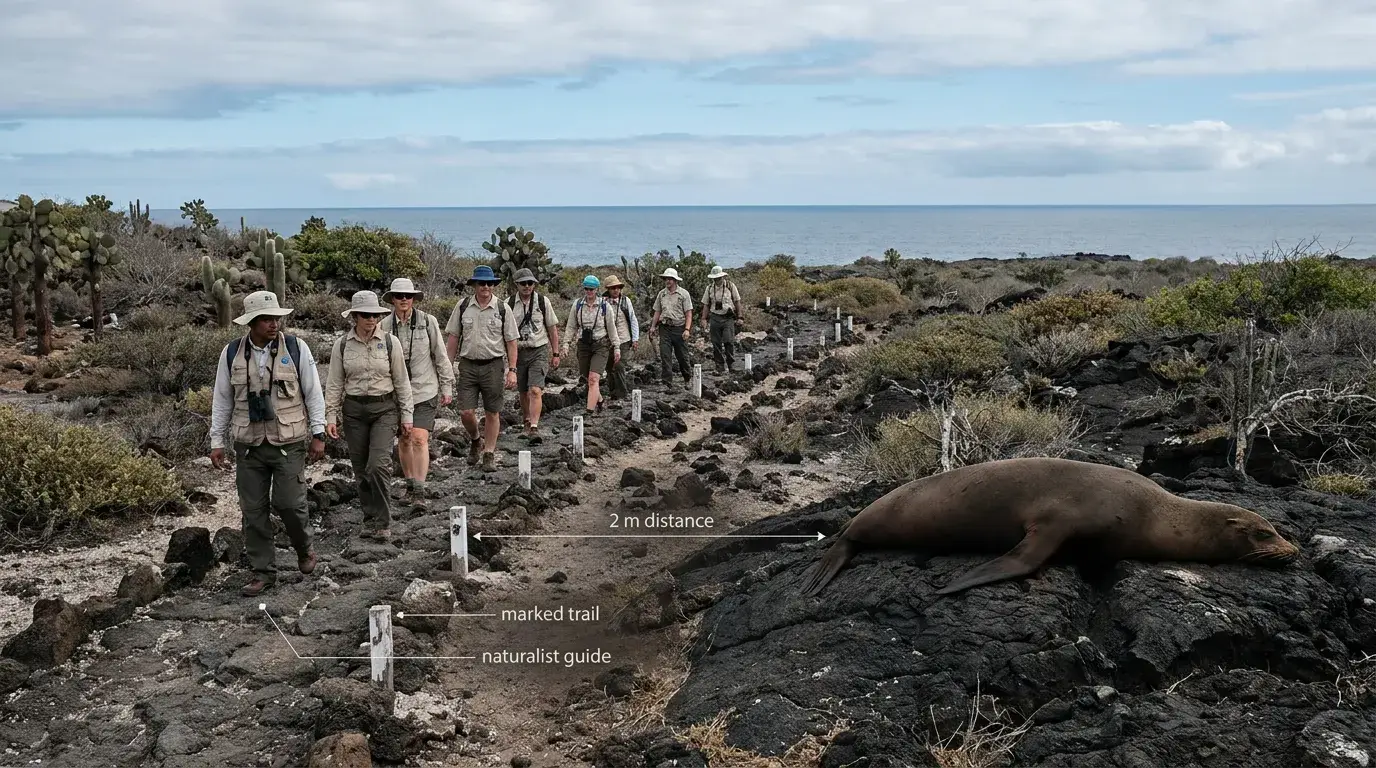
Keep 2 m (6 ft) from wildlife
On trails and in the water, camera and phone included. 4 m by kayak, paddleboard or panga; 100 m from whales and 50 m from dolphins, doubled with calves.
GALAPAGOS NATIONAL PARK · VISITOR RULES
Twelve rules keep these islands wild. Here is what each one means on a real landing, with the 2026 updates and a quick quiz to test yourself.
Galapagos National Park rules — Reference image only.
The figures every visitor meets, from the official rules and fees. Tap through the rest of the page to see how they play out on a real trip.
Summarized from Resolution MAE-PNG/DIR-2026-0044-RM (official PDF), Article 4, and the park’s official visit rules. Wording simplified for US travelers.
On trails and in the water, camera and phone included. 4 m by kayak, paddleboard or panga; 100 m from whales and 50 m from dolphins, doubled with calves.
Visits to protected areas are led by a park-accredited Galapagos naturalist guide, except at the few sites the park exempts.
Walk only on signposted trails, beach areas and marine zones open to visits. If a sea lion blocks the path, wait; step around only if you truly cannot continue.
That includes dead animals and nests, resting and breeding areas. Never swim with or chase whales or dolphins.
Photos are taken without flash or any device that changes animal behavior.
Drones, professional filming, remote cameras and underwater rigs need prior authorization from the park (DPNG).
Food brought into sites is subject to biosecurity rules, and alcohol, smoking, vaping and fire are banned in protected areas. Eat on board; carry water.
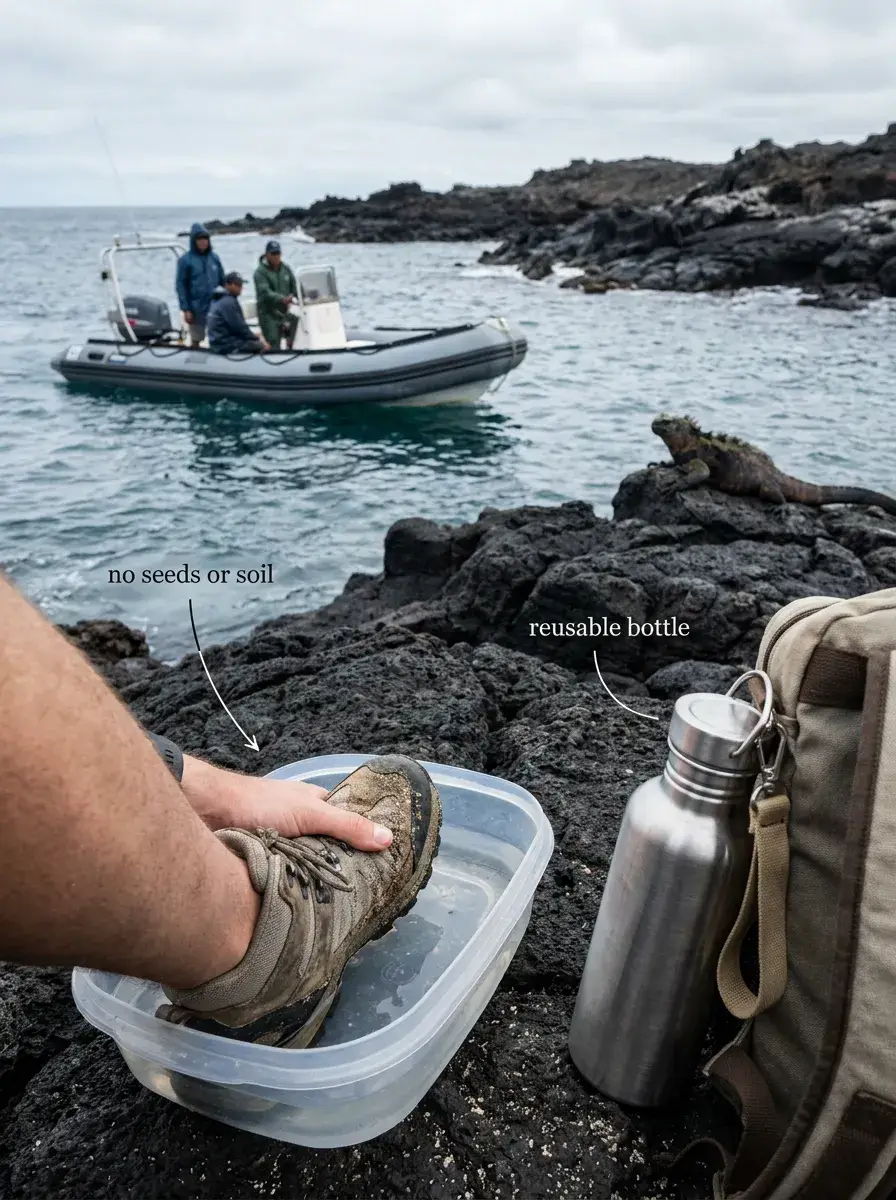
Bags are inspected on the way to and between islands. Clean boots and gear; declare fresh food.
Carry out every piece of trash. Galapagos also restricts single-use plastics: bring a refillable bottle.
Sand, shells, coral, volcanic rock, plants or animal parts stay where they are. No buying them either.
Sites open 6:00–18:00. Six sites now need an advance reservation, and each guide leads a small group.
Sunscreens with oxybenzone or octinoxate are restricted during water activities.
The situations that come up on almost every landing.
Most of the species you came to see live nowhere else, and the biggest threat to them is something arriving by accident: a seed in a boot tread, an insect in fruit, soil on a tripod. That is why bags are inspected before the flight from Quito or Guayaquil, and can be inspected again between islands and at visitor-site control points.
Pack smart: clean hiking shoes and gear before you travel, skip fresh fruit and plants, use a refillable bottle (single-use plastics are restricted in Galapagos) and bring a mineral sunscreen without oxybenzone or octinoxate. Our 2026 park rules guide has the full label check.
Where each rule shows up on a typical 2026 itinerary.
Book with a licensed operator; licensed vessels hold set itineraries and site permits. Pack reef-safe sunscreen, a refillable bottle and clean gear.
Buy the US$20 Transit Control Card (TCT) and pass the biosecurity bag inspection before the flight to the islands.
Pay the park entry fee (US$200 per foreign adult, US$100 under 12) to park rangers on arrival. Keep your receipt.
Your naturalist guide explains wet and dry landings, distances and the day plan. Fresh food goes through the boat’s own controls.
Clean shoes, stay with your group, keep 2 m, no flash, take nothing. Rangers may check bags at control points.
2 m from turtles and sea lions, 4 m by kayak or panga, reef-safe sunscreen only, no chasing.
Bags can be inspected again between islands to stop seeds and insects moving around the archipelago.
Leave shells, sand and rocks behind; they can be confiscated at the airport. Share photos taken legally only.
Article 6 of the resolution: entry must be booked in advance through the park’s system by a tour agency registered in Galapagos, and your guide shows the slot at the entrance. The park can add sites later.
| Visitor site | Island | Type |
|---|---|---|
| Fausto Llerena Breeding Center (Tortoise Route) | Santa Cruz | Tortoise breeding center |
| Arnaldo Tupiza Breeding Center | Isabela | Tortoise breeding center |
| David Rodríguez Breeding Center | San Cristóbal | Tortoise breeding center |
| Las Grietas | Santa Cruz | Visitor site |
| Volcán Chico | Isabela | Visitor site |
| Sulfur Mines (Minas de Azufre) | Isabela | Visitor site |
Visitor sites are open 6:00 a.m. to 6:00 p.m.; diving until 5:00 p.m. Each site also has a visitor capacity, which is why licensed boats keep to assigned times and small groups led by one guide.
Six real situations. Pick an answer to see what the rules say.
Question 1 of 6
Keep your distance and avoid any interaction, even when the animal approaches. If it blocks the trail, wait.
Question 2 of 6
Drones, remote cameras and professional filming need prior authorization from the Galapagos National Park Directorate.
Question 3 of 6
Sunscreens with oxybenzone or octinoxate are restricted in water activities. Check the label for benzophenone-3 too.
Question 4 of 6
Taking, transporting, buying or keeping sand, shells, coral or rocks from protected areas is prohibited.
Question 5 of 6
Las Grietas is one of six sites (with three tortoise breeding centers, Volcán Chico and the Sulfur Mines) that need an advance reservation.
Question 6 of 6
Boats keep 100 m from whales, doubled to 200 m when calves are present.
We check the rules against the official texts. Fees and site lists can change; always confirm before you travel.
Last checked: October 19, 2026.
Visit protected areas only with a licensed naturalist guide, stay on marked trails, keep at least 2 m (about 6 ft) from wildlife, never touch or feed animals, take photos without flash, take nothing natural away and leave no trash. Drones need a park permit. The current text is Resolution MAE-PNG/DIR-2026-0044-RM (official PDF).
It is the Galapagos National Park Directorate’s “General Visit Rules and Behavior Standards for the Protected Areas of Galapagos”, signed in Puerto Ayora on August 12, 2026 and published in Ecuador’s Registro Oficial (Third Supplement No. 368) on September 14, 2026. It sets distances by activity, the reservation system for six sites, sunscreen limits and visiting hours. Our post on the Galapagos National Park rules 2026 explains it in detail.
Yes. The 2 m distance applies on walks, snorkeling, freediving and diving, and it includes your camera or phone. Rangers patrol visitor sites, can check bags at control points and can review social media posts when there are signs a rule was broken.
Not at visitor sites without prior authorization from the Galapagos National Park Directorate. The same applies to professional filming, remote cameras and underwater or aerial rigs. Footage obtained without permission may not be published.
At the time of writing, US$200 per foreign adult and US$100 per child under 12, paid on arrival at Baltra or San Cristóbal, plus the US$20 Transit Control Card bought at the mainland airport before you fly. Fees can change, so check the official Galapagos National Park Directorate: entry fee page before you travel.
Food and gear brought into Galapagos go through biosecurity inspection, and fresh fruit, seeds, soil and live organisms are restricted. On a cruise or charter you eat on board; on landings you carry only water, and alcohol, smoking and fires are banned inside protected areas.
Not much in practice: licensed boats already sail approved itineraries with a naturalist guide and set site slots. If you want a private boat for your group, see Galapagos yacht charter options, or compare Galapagos cruises on shared boats.
A private charter or a well-chosen cruise keeps you inside every rule without thinking about it. Tell us your dates and group.
Galapagos is unlike anywhere else on Earth because these rules work. Ingenio created this site to share clear, independent information; write to hola@galapagosislands.cruises with any question.