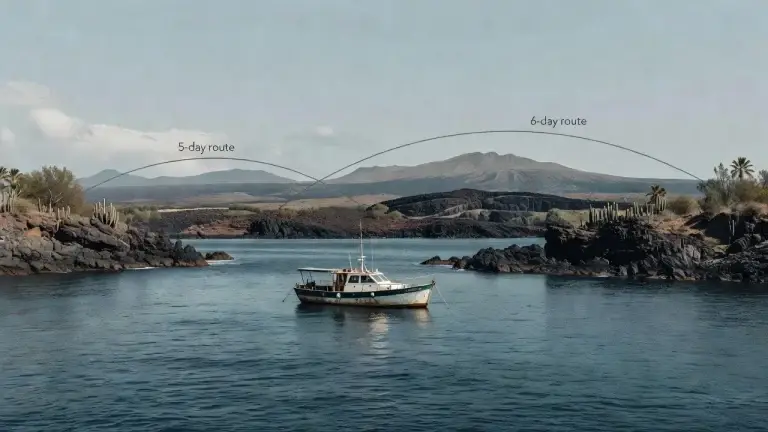
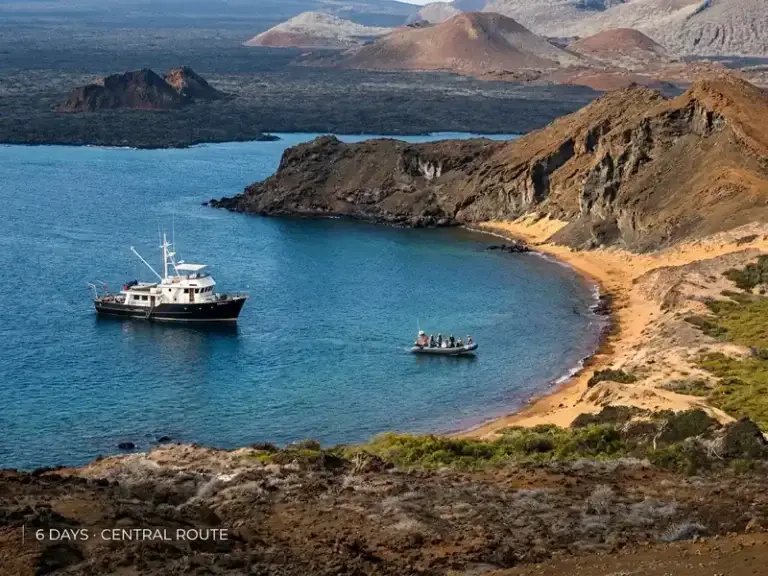
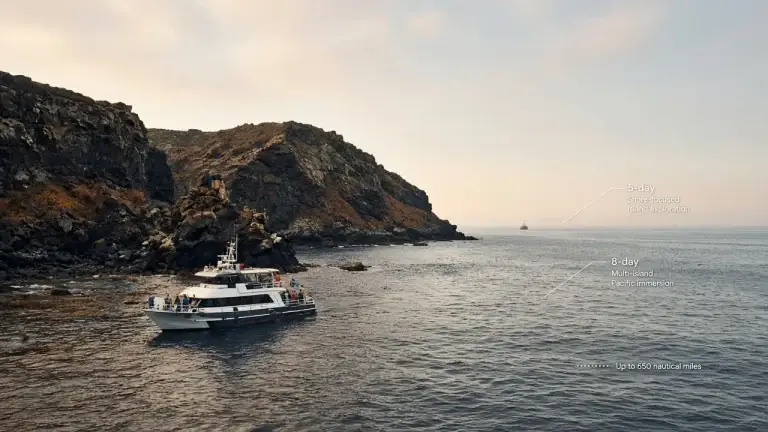
Park-approved routes
Each boat holds fixed itineraries on its permit. You choose a route by choosing the boat and departure date.
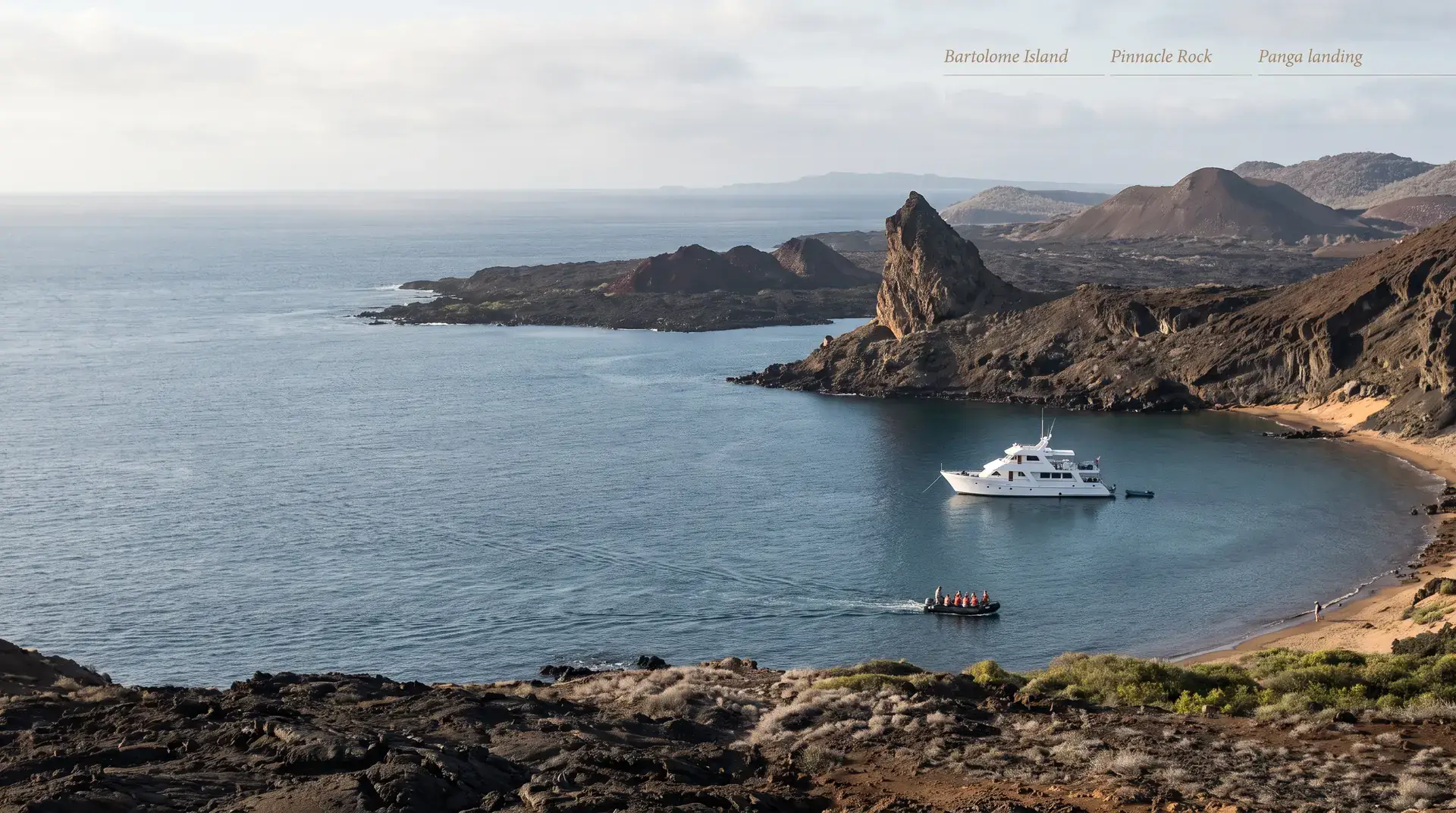
GALAPAGOS CRUISES 2026–27
Ships, routes, lengths and seasons side by side, so you can pick the cruise that fits how you travel.
Galapagos cruises — Reference image only.
Six facts shape every cruise in the islands, whatever the boat or price.
Each boat holds fixed itineraries on its permit. You choose a route by choosing the boat and departure date.
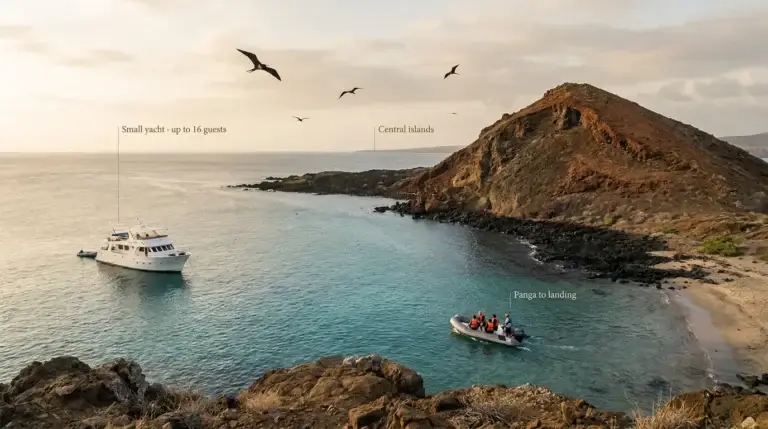
Most boats carry 16 to 20 guests; the largest carry 100. There are no big cruise liners.
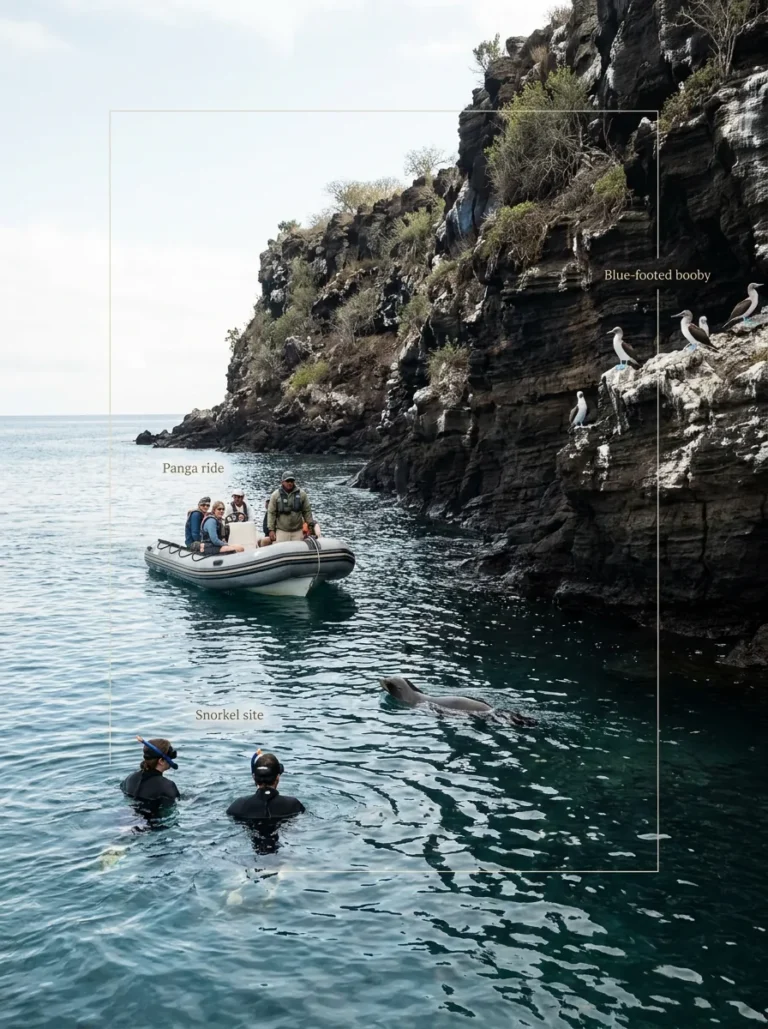
A guided walk and a snorkel, kayak or panga ride, morning and afternoon.
Park-accredited guides lead every landing, with at most 16 visitors per guide. About guides
Boats move between islands mostly at night, so days are for exploring.
Cruises begin at Baltra or San Cristóbal; you fly in from Quito or Guayaquil. Getting there
The route matters more than the cabin. Every boat sails one or more of these regions.
| Route | Main islands | Signature wildlife | Best for |
|---|---|---|---|
| Eastern | Española, San Cristóbal, Santa Fe, Floreana | Waved albatross (about April–December), sea lions | First trips, snorkeling |
| Northern | Genovesa, Bartolomé, Santiago, North Seymour | Red-footed boobies, frigatebirds | Birders, photographers |
| Western | Isabela, Fernandina | Penguins, flightless cormorants | Wildlife enthusiasts, repeat visitors |
Full guide: Galapagos cruise itineraries · Islands: Galapagos islands guide
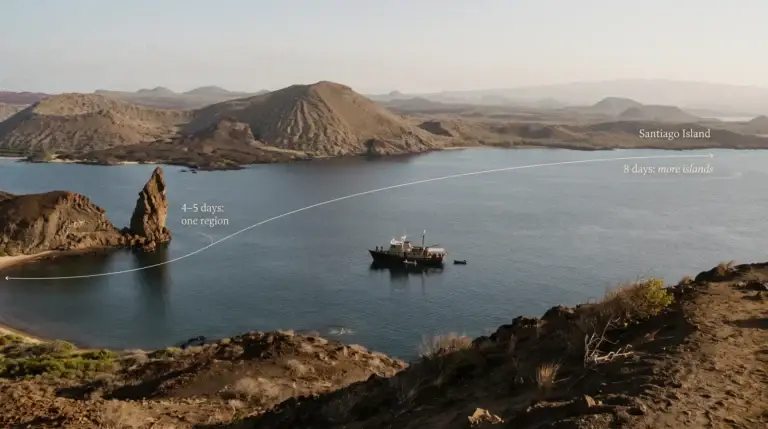
Start with the animals and landscapes you most want to see, because each region of the archipelago is different. The eastern islands are the oldest, with soft beaches, sea lion colonies and, from about April to December, the waved albatross of Española. The northern islands are about seabirds: Genovesa’s red-footed boobies and frigatebirds, and the view over Pinnacle Rock at Bartolomé. The western islands, Isabela and Fernandina, are young and volcanic, where penguins and flightless cormorants live in the cold, nutrient-rich water.
Next, decide how many days you have. A 4 or 5-day cruise covers one region well; 7 or 8 days lets you see a full loop at an unhurried pace. Add a night in Quito or Guayaquil on each side so a delayed flight does not cost you a day at sea.
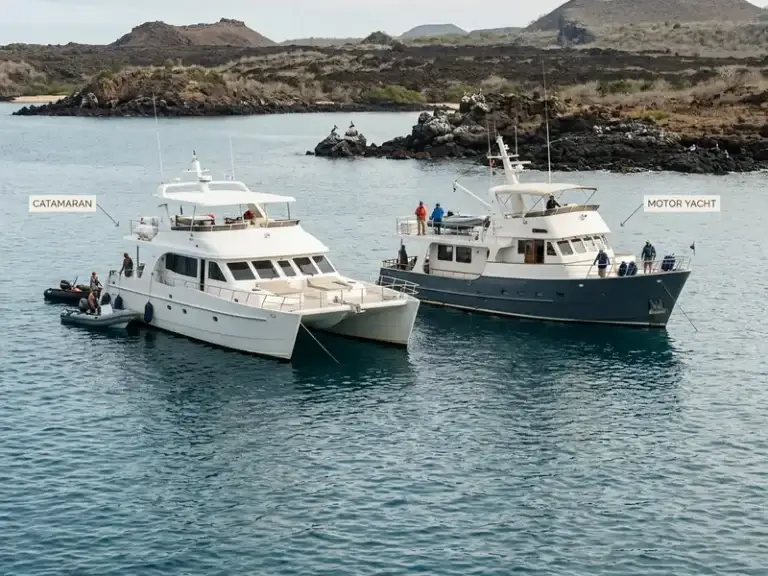
Then choose the boat. Size changes the feel of the trip more than anything else: a 16-guest yacht feels like a private house party with one naturalist group; a 100-guest expedition ship is steadier, with lectures and more space, but several groups take turns at each site. Catamarans offer wide decks and many balcony cabins; motor yachts are the classic Galapagos boat.
Finally, set the class and cabin. Tourist, first-class and luxury boats share the same visitor sites and the same park rules; what changes is cabin size, food, service and the experience of the guides. Midship and lower-deck cabins move less on crossings, which matters if you are prone to seasickness.
If you are traveling with a big family or a group of friends, check whether Galapagos charters would give you the whole boat for a similar per-person cost.
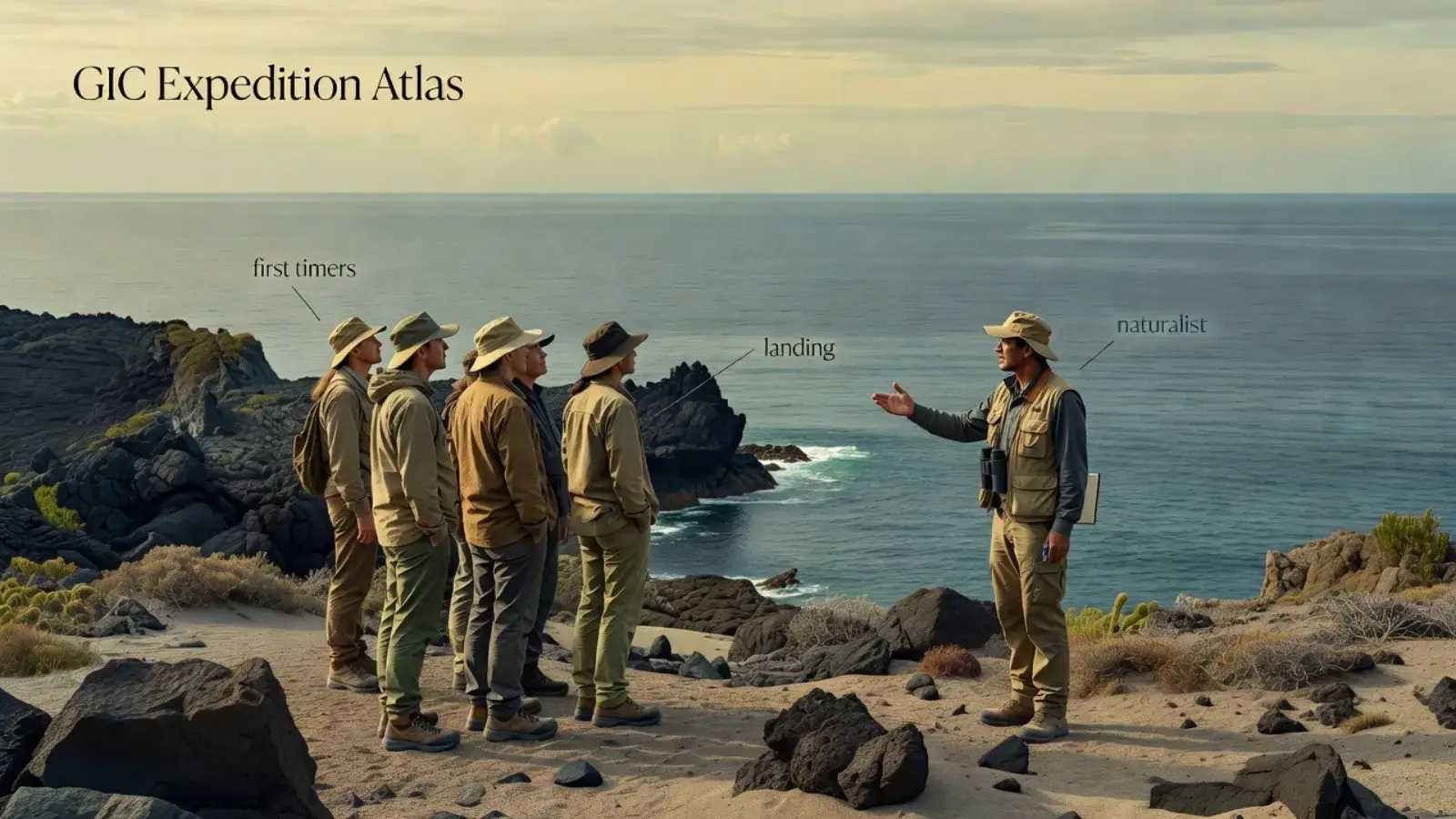
Most first-timers choose 5 to 8 days. Longer trips combine two routes.
| Type | Guests | Feel on board | Guide |
|---|---|---|---|
| Catamarans | 16–20 | Wide decks, big windows, less roll at anchor | Best for space and balconies |
| Motor yachts | 16–20 | Classic, intimate, one or two groups | Best for small-group feel |
| Small ships | 20–48 | Middle ground, more facilities | Best for value and stability |
| Expedition ships | 48–100 | Steadier, lectures, more amenities | Best for motion-sensitive travelers |
All ships: Galapagos cruise ships · Ships with balconies · Interconnecting cabins · Diving liveaboards
Filter by type. Each guide lists specs, cabins and itineraries; no invented prices.
| Ship | Type | Guests |
|---|---|---|
| Alya | Luxury Catamaran | 16 |
| Endemic | Luxury Catamaran | 16 |
| Elite | Luxury Catamaran | 16 |
| Hermes | Luxury Catamaran | 20 |
| Aqua Mare | Luxury Motor Yacht | 16 |
| Infinity | Luxury Motor Yacht | 20 |
| Grand Majestic | Luxury Motor Yacht | 16 |
| Origin | Motor Yacht | 20 |
| Theory | Motor Yacht | 20 |
| Evolve | Motor Yacht | 20 |
| Galapagos Sea Star | Luxury Motor Yacht | 16 |
| La Pinta | Luxury Cruise Ship | 48 |
| Silver Origin | Luxury Cruise Ship | 100 |
| Celebrity Flora | Luxury Cruise Ship | 100 |
| Aggressor III | First Class Diving Yacht | 16 |
| Aida Maria | Mid Range Motor Yacht | 16 |
| Anahi | First Class Catamaran | 16 |
| Archipel I | Mid Range Catamaran | 16 |
| Beluga | First Class Motor Yacht | 16 |
| Bonita | Mid Range Motor Yacht | 16 |
| Cachalote Explorer | First Class Motor Yacht | 16 |
| Calipso | First Class Motor Yacht | 16 |
| Calipso Diving | First Class Diving Yacht | 16 |
| Coral I & Coral II | First Class Motor Yacht | 36 |
| Danubio Azul Diving | Budget Diving Yacht | 16 |
| Danubio Azul Naturalist | Budget Motor Yacht | 16 |
| Eco Galaxy | First Class Catamaran | 16 |
| Eden | Mid Range Motor Yacht | 16 |
| Evolution | Luxury Cruise Ship | 32 |
| Fragata | Mid Range Motor Yacht | 16 |
| Galapagos Angel | First Class Motor Yacht | 16 |
| Galapagos Explorer | Luxury Motor Yacht | 12 |
| Galapagos Horizon | Luxury Catamaran | 16 |
| Galapagos Legend | Luxury Cruise Ship | 100 |
| Galapagos Master | First Class Diving Yacht | 16 |
| Galapagos Sky | First Class Diving Yacht | 16 |
| Galaxy Diver II | First Class Diving Yacht | 16 |
| Galaxy Diver III | First Class Diving Yacht | 16 |
| Galaxy I | Motor Yacht | 16 |
| Galaxy Orion | Mid Range Motor Yacht | 14 |
| Galaxy Sirius | Luxury Catamaran | 16 |
| Galaxy Stella | First Class Motor Yacht | 12 |
| Golondrina | Motor Yacht | 16 |
| Grace | Luxury Motor Yacht | 16 |
| Grand Daphne | First Class Motor Yacht | 16 |
| Grand Ocean Spray | Luxury Catamaran | 16 |
| Grand Queen Beatriz | First Class Motor Yacht | 16 |
| Humboldt Explorer | First Class Diving Yacht | 16 |
| Integrity | Luxury Motor Yacht | 16 |
| Isabela II | Luxury Cruise Ship | 40 |
| Köln | Mid Range Motor Yacht | 16 |
| Letty | First Class Motor Yacht | 20 |
| Monique | Luxury Catamaran | 16 |
| Monserrat | First Class Motor Yacht | 16 |
| National Geographic Delfina | Luxury Motor Yacht | 16 |
| National Geographic Endeavour II | Luxury Cruise Ship | 96 |
| National Geographic Gemini | Luxury Cruise Ship | 48 |
| National Geographic Islander II | Luxury Cruise Ship | 48 |
| Natural Paradise | Luxury Motor Yacht | 16 |
| Nemo II | Mid Range Catamaran | 14 |
| Nemo III | First Class Catamaran | 16 |
| Ocean Spray | Luxury Catamaran | 16 |
| Passion | Luxury Motor Yacht | 14 |
| Petrel | Luxury Catamaran | 16 |
| Reina Silvia Voyager | First Class Catamaran | 16 |
| Samba | Mid Range Motor Sailor | 14 |
| Santa Cruz II | Luxury Cruise Ship | 90 |
| Seaman Journey | First Class Catamaran | 16 |
| Solaris | Mid Range Motor Yacht | 16 |
| Tiburon Explorer | First Class Diving Yacht | 16 |
| Tip Top II | First Class Catamaran | 16 |
| Tip Top IV | First Class Motor Yacht | 16 |
| Tip Top V | First Class Catamaran | 16 |
| Treasure of Galapagos | First Class Catamaran | 16 |
| Tribute | Luxury Motor Yacht | 16 |
| Yolita II | Mid Range Motor Yacht | 16 |
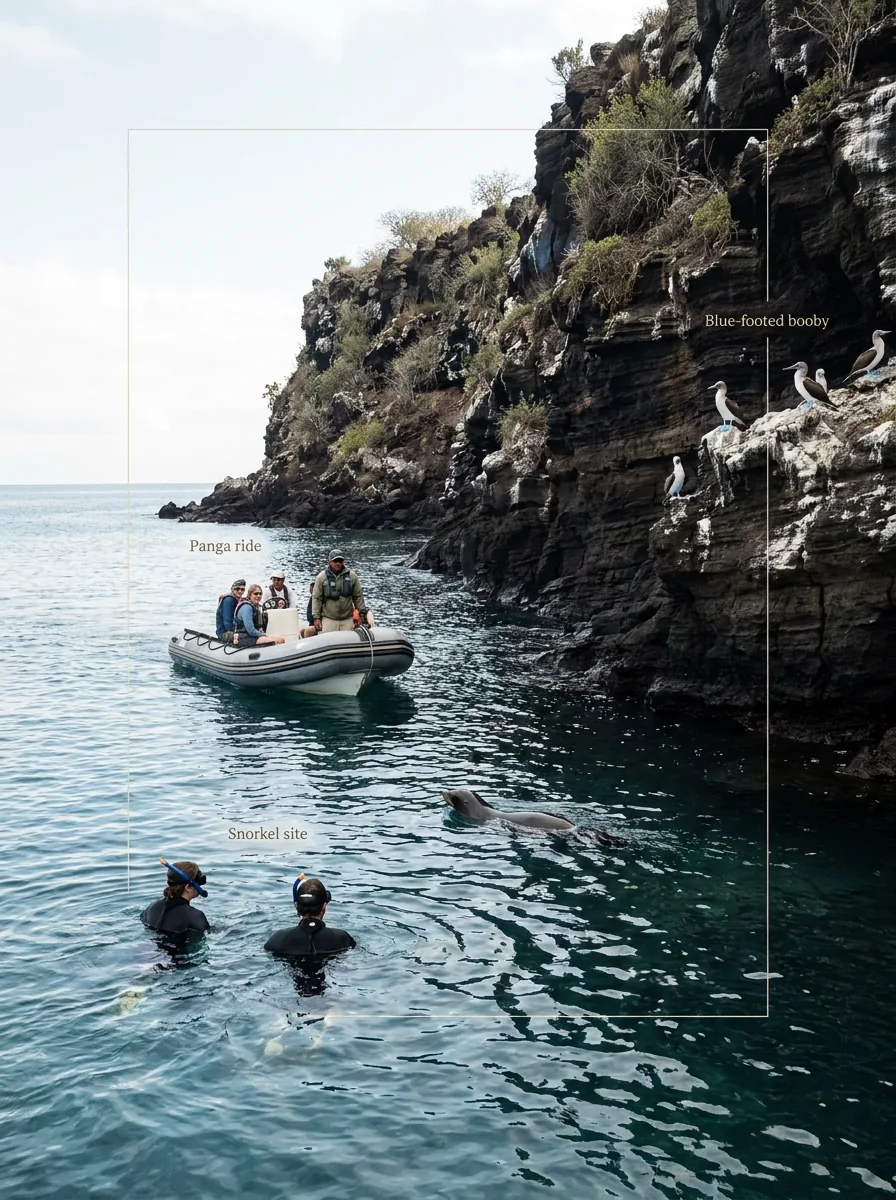
Days start early, often with breakfast around 7:00, because wildlife is most active and the light is softer in the morning. The first outing is usually a landing: the panga (dinghy) takes you ashore for a wet or dry landing and a guided walk of one to three kilometers on a marked trail.
Back on board, there is time for a snack and a snorkel, kayak or paddleboard session, depending on the site and the boat. Lunch is served while the boat repositions. The afternoon brings a second outing, then a briefing where your naturalist explains the next day’s plan, followed by dinner. Most crossings happen at night.
Read more about Galapagos cruise activities, visitor sites and food on board.
Answer the questions to see a suggestion.
Start with luxury cruises.
Luxury Galapagos cruises: Suites, balconies, top guides.
Start with budget cruises.
Budget Galapagos cruises: Tourist and tourist-superior boats.
Start with family cruises.
Family Galapagos cruises: Kid-friendly boats and cabins.
Start with couples cruises.
Couples Galapagos cruises: Doubles, balconies, quiet decks.
Start with seniors cruises.
Seniors Galapagos cruises: Easy landings and steadier boats.
Start with solo cruises.
Solo Galapagos cruises: Share options and single cabins.
Price depends on boat class (tourist to luxury), length, season and cabin. Fares rarely include the mainland–island flights, the national park fee or the Transit Control Card, so compare full quotes, not headline rates.
Shoulder months often offer better value; holidays and July–August sell out first. Single travelers usually pay a supplement. A group filling a boat may pay less per person with Galapagos charters.
Galapagos cruise cost guide · What all-inclusive means · Early vs last-minute

Galapagos boats are sold in classes: tourist, tourist superior, first class and luxury. Every class visits the same kinds of sites, follows the same park rules and carries accredited naturalists. The differences are on board: cabin size and beds, windows versus balconies, food, service levels, and often the experience and license level of the guide.
Tourist-class boats suit budget travelers who mostly want the islands; first-class boats balance comfort and value; luxury boats add suites, balconies, more crew per guest and extras such as drinks, kayaks and paddleboards. Older boats can be excellent if well maintained, so look at recent reviews rather than the build year alone.
Compare options in our luxury Galapagos cruise and budget Galapagos cruise guides, and read how to read cruise reviews.
| Season | Months | Seas and water | Highlights |
|---|---|---|---|
| Warm season | December–May | Calmer seas, warmer water | Turtle nesting, green islands, great snorkeling |
| Cool season | June–November | Cooler water, choppier crossings | Seabird courtship, sea lion pups, richer marine life |
Galapagos animals evolved without large predators, so most show little fear of people. On almost any cruise you will see Galapagos sea lions, marine iguanas, blue-footed boobies, frigatebirds, Sally Lightfoot crabs, sea turtles and reef fish. Giant tortoises are easiest to see in the highlands of Santa Cruz, which most itineraries visit.
Some species need the right route: waved albatross on Española (eastern), red-footed boobies on Genovesa (northern), penguins and flightless cormorants around Isabela and Fernandina (western). See our Galapagos wildlife guide for where and when.

| Shared cruise | Land-based | Private charter | |
|---|---|---|---|
| How it works | Book cabins on a boat with other guests | Hotel in town, day trips | Whole boat for your group |
| Islands reached | Remote sites included | Mostly central islands | Remote sites included |
| Best for | Most travelers | Tight budgets, seasick-prone | Families and groups |
| Learn more | Compare cruises | Island hopping vs cruise | Galapagos charters |
Cabins on Galapagos boats are compact. Doubles suit couples, twins suit friends, and a few boats have triples or interconnecting cabins for families. Solo travelers usually pay a single supplement; some boats offer share options. See cabins and solo travel and family cabins.
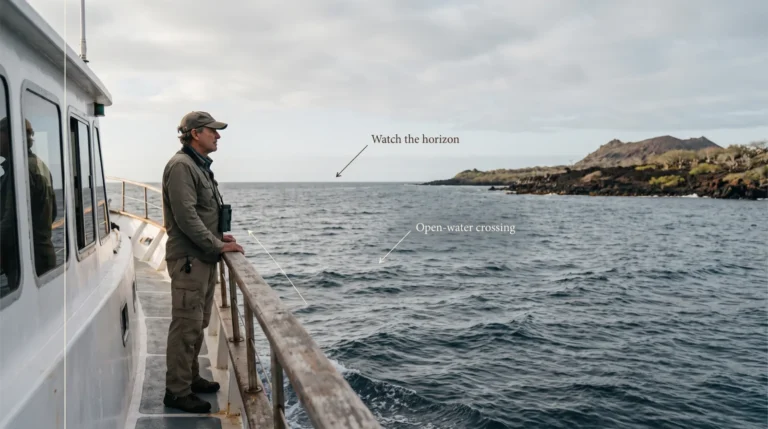
Seas are usually moderate, but open-water crossings can be choppy, especially from August to October. Larger ships and catamarans move differently from single-hull yachts; midship, lower-deck cabins move least. Our seasickness tips explain what helps.
Seasons, seas and wildlife by month.
What drives the price, honestly.
Flights from the US via Ecuador.
Passport, TCT, park fee, biosecurity.
Interactive checklist.
Cabin types and single options.
Visa rules for US citizens · Park entrance fee · Transit Control Card
Flying from the US · Baltra or San Cristóbal · Arrive a day early
Built from 40+ trips and our records of 76 ships and 841 itineraries.
Side by side, up to three ships.
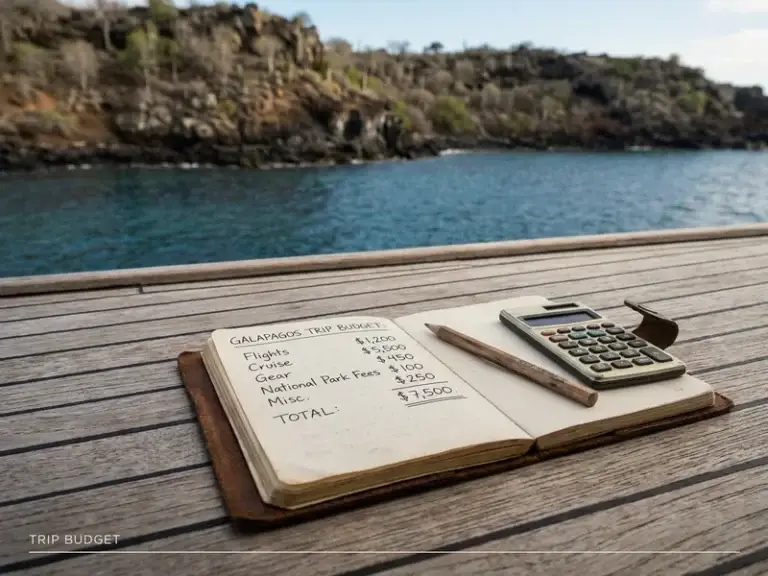
Fees, flights and extras in one total.
Share a charter fairly.
Work back from your sailing date.
Which islands, which months.
A complete brief in two minutes.

Warm season; water 72–77 °F.
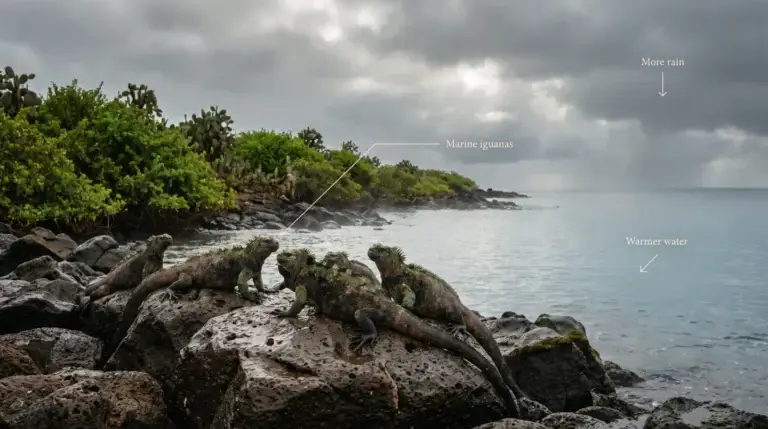
Warm season; water 75–79 °F.
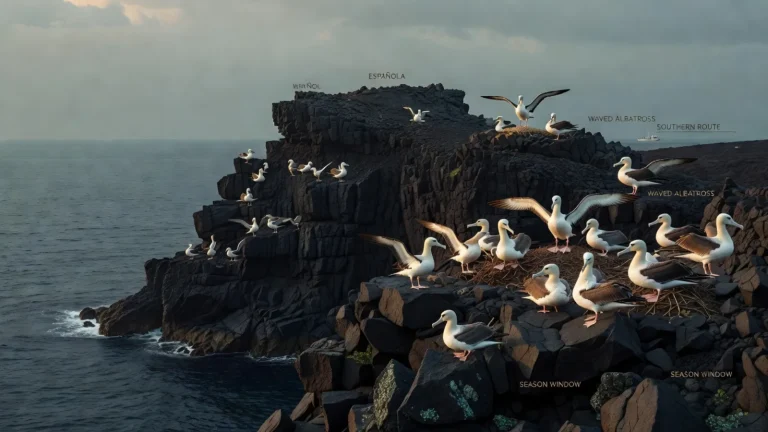
Peak of the warm season; water 77–80 °F.
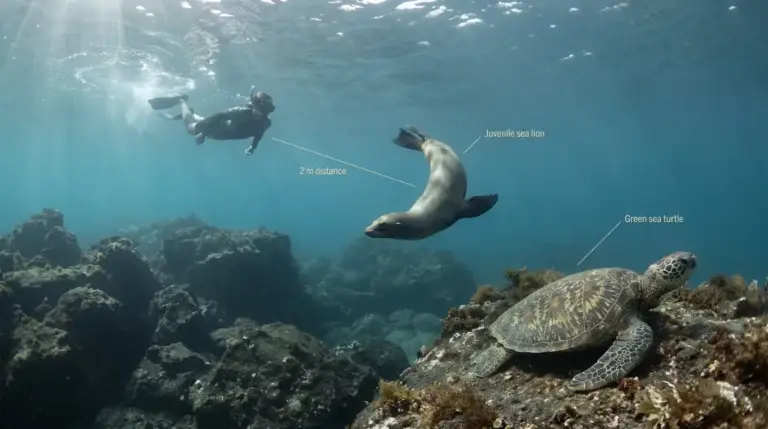
Warm season; water 75–79 °F.

Transition between seasons; water 73–77 °F.
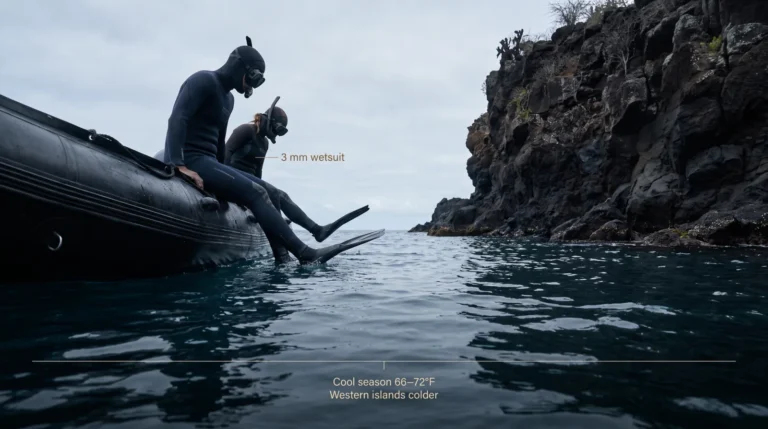
Start of the cool garúa season; water 70–75 °F.
Cool season; water 68–73 °F.

Cool season; water 66–72 °F.
Cool season; water 66–70 °F.
Easing cool season; water 68–72 °F.
End of the cool season; water 70–73 °F.

Start of the warm season; water 72–75 °F.

Seasons, 2027 holidays, deadlines, checklists.
The wildlife calendar on one page.
Every step of a private charter.
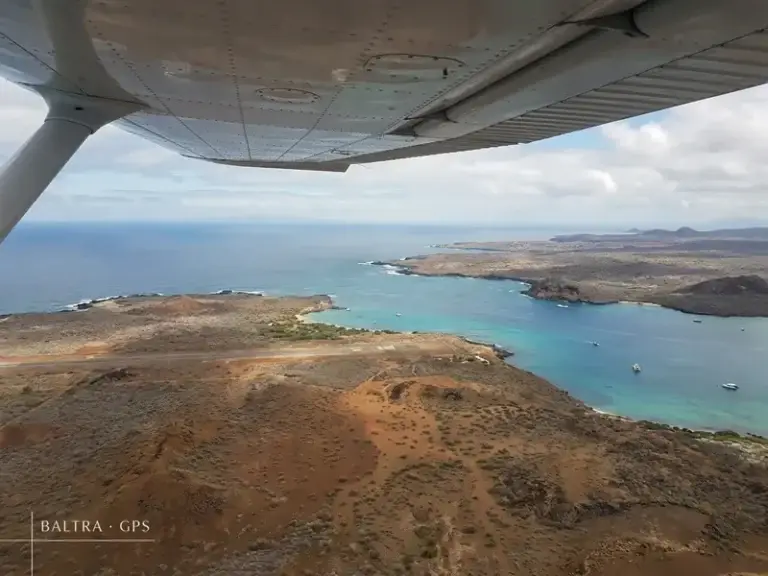
Flights, entry and timing for US travelers.
There is no single best: it depends on route, boat size and budget. Use our cruise finder for a shortlist.
5 to 8 days suits most first trips; 4 days is a short taster.
It varies widely by class, length and season; ask for full quotes including flights and fees.
Any month works: December–May for warm, calm seas; June–November for cooler, richer seas.
Meals, guided excursions and snorkel gear usually are; flights, park fee, drinks and tips often are not.
Average fitness is enough; walks are short and you can skip outings.
For remote islands, yes. Land-based trips suit tight budgets and people prone to seasickness.
No. We are the creators of this site, local experts who inform and compare, and connect you with boats.
Yes. Email hola@galapagosislands.cruises with dates, group size and interests.
Email your dates, group and wish list. We reply with a short, honest shortlist of boats and routes.
Galapagos is unlike anywhere else on Earth: wildlife that does not run from you, islands still shaped by volcanoes, and a park that limits every visit. Tell us how you like to travel and we will match you with the right boat.