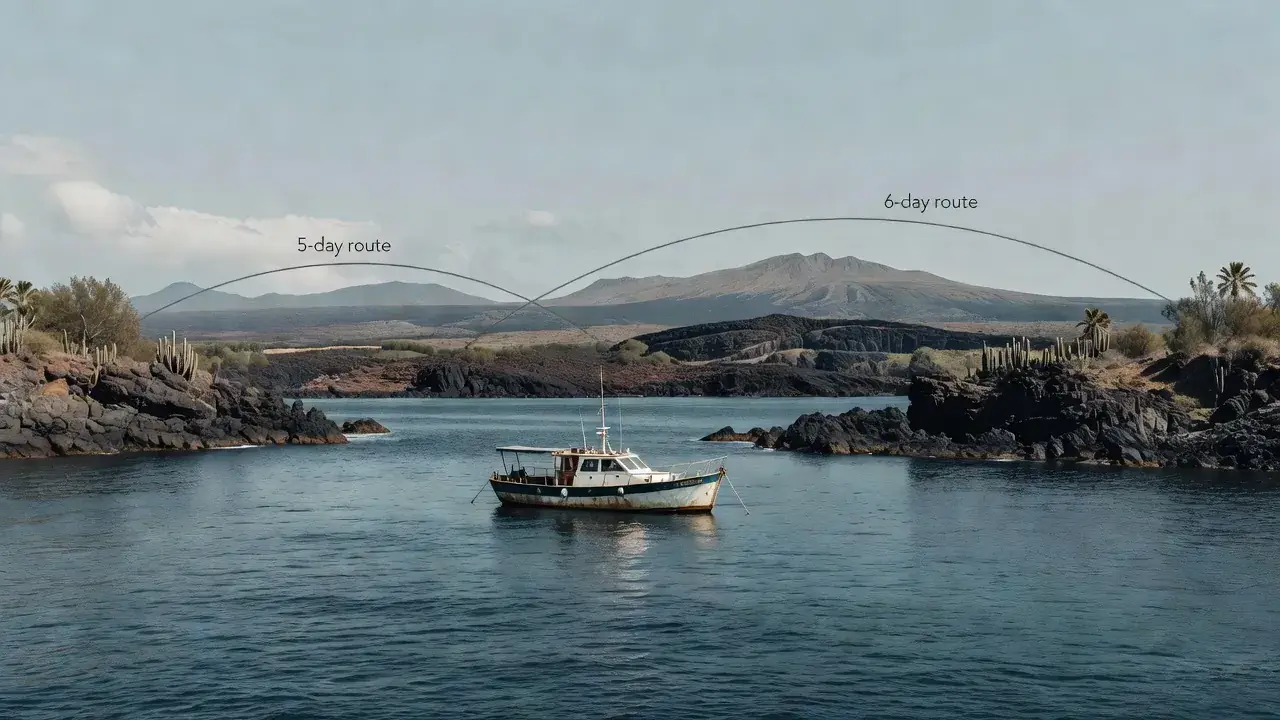
A 5-day vs 6-day Galapagos cruise decision is really about one extra sailing day—how many visitor sites you can string together, how rushed landings feel, and whether your US travel window can absorb the longer pattern. Neither length invents wildlife guarantees. Use day-by-day itinerary letters, not brochure adjectives, before you lock a cabin.
5-day vs 6-day Galapagos cruise: what is the quick answer?
Quick answer: choose the shorter side of a 5-day vs 6-day Galapagos cruise when your calendar is tight and you still want a full shipboard rhythm with several landings; choose the longer side when you want one more visitor-site block, more snorkel or hike pacing, and less “airport-to-ship compression.” Skip either length if the published route does not match the habitats you care about—duration alone does not fix a mismatched letter.
That is the practical core of a 5-day vs 6-day Galapagos cruise. In the Galápagos, commercial sailings follow park-permitted itineraries with licensed naturalists.
A serious 5-day vs 6-day Galapagos cruise decision therefore starts with the day-by-day visitor-site list for your departure week, then maps how embarkation and disembarkation days eat into “full” activity days.
Use this rule of thumb
- Prefer 5-day patterns when flights and mainland buffer nights already compress your US leave window.
- Prefer 6-day patterns when you want one extra landing or snorkel block without jumping to a full week-plus sailing.
- Always read the published itinerary letter before cabin photos decide a 5-day vs 6-day Galapagos cruise.
- Treat wildlife as habitat access plus season and conditions—not a promise tied to duration.
Start with the Finder, compare longer-vs-shorter framing in our 5-day vs 8-day Galapagos cruise guide, and browse vessel options on cruise ships.
Which islands and visitor sites shape this choice?
Islands and visitor sites—not marketing day counts—shape a 5-day vs 6-day Galapagos cruise. Two sailings labeled “5-day” or “6-day” can visit different regions entirely.
How embarkation days count
Many catalogs count calendar nights aboard, including embarkation and disembarkation. A 5-day label may deliver fewer full landings than a 6-day label on the same vessel class. Ask for the day-by-day visitor-site list with approximate AM/PM blocks. That list is the product. US travelers should also confirm whether the first afternoon is a soft landing or mainly briefing and settling in.
Regional patterns matter more than the digit
Some short sailings emphasize central islands; others lean west or north depending on the vessel’s permitted letter. An extra day can add a second habitat type—or simply deepen time in the same region. When you evaluate a 5-day vs 6-day Galapagos cruise, ask which regions the letter covers, not only how many days appear in the title. A mismatched region on a longer label is still a mismatch.
Visitor-site clocks still apply
Park rules limit time ashore. A longer sailing may add sites, but each landing still runs on a clock. Confirm whether the extra day adds a new visitor site, a second snorkel window, or mainly transit. That distinction keeps a 5-day vs 6-day Galapagos cruise honest and prevents “one more day” from becoming an empty slogan.
What wildlife and activities may differ between the options?
Wildlife and activities may differ because the itinerary letter differs—not because six days magically “guarantee” more animals than five. Frame a 5-day vs 6-day Galapagos cruise as habitat access and activity pacing.
Landings and hiking intensity
An extra day can add another dry or wet landing, another shoreline hike, or a second visit pattern in a similar habitat. It can also simply give the naturalist more room to pace slower walkers. Ask how many landings appear on each published letter and whether any days are double-activity.
Snorkel and panga windows
Snorkel quality depends on site, season, and conditions. A longer sailing may include one more water activity block; it does not promise specific species. Compare the listed snorkel or panga opportunities on both letters when you weigh a 5-day vs 6-day Galapagos cruise. If snorkeling is a priority, count water blocks explicitly rather than assuming the longer label automatically delivers them.
Briefings and evening rhythm
More days aboard mean more briefing cycles and more shared evenings—useful if you want deeper naturalist context, less useful if you are already near your flight limits. Activity differences are real; wildlife guarantees are not. Evening talks, photo reviews, and rest windows also expand slightly when the letter is longer.

How does trip length change what you can realistically cover?
Trip length changes coverage and pacing—the heart of any 5-day vs 6-day Galapagos cruise.
Calendar math for US travelers
Count mainland Ecuador buffer nights, island flights, and cruise nights as one chain. A 6-day cruise may push you past a tight leave window even if the “extra day” looks small on a brochure. Build the full chain before you compare only ship nights. Include recovery time after overnight flights from the United States so the first landing is enjoyable, not exhausted.
Transit versus exploration
Some days are dominated by navigation between regions. An extra calendar day can be exploration-heavy or transit-heavy depending on the letter. Ask which days are primarily movement versus landing-rich. That question separates a meaningful 5-day vs 6-day Galapagos cruise from a label contest.
Diminishing returns versus step-ups
Moving from 5 to 6 days is a smaller step than jumping to an 8-day or longer pattern. If your goal is multi-region coverage, read our 5-day vs 8-day comparison after you settle the short-band choice. If your goal is a first taste with limited leave, the shorter side can still deliver a complete shipboard rhythm with several landings and snorkel windows.
Cost factors without invented sticker prices
Speak in drivers: vessel class, season, sailing length, cabin category, and inclusions. Park entrance, Transit Control Card, island flights, tips, and some beverages often sit outside headline figures. Compare itemized proposals for the same month and similar vessel class when duration is the variable. An extra night changes the total—but only itemized lines show how.
Who should choose this route or duration?
Different travelers land on different sides of a 5-day vs 6-day Galapagos cruise.
Choose the 5-day side when…
- Your US leave window is tight after flights and buffer nights.
- You want a complete cruise rhythm without committing to a week-plus.
- The published 5-day letter already hits the habitats you prioritize.
- You prefer fewer nights aboard and a simpler packing/recovery plan.
Choose the 6-day side when…
- You can absorb one more night without stressing connections.
- The published 6-day letter adds a visitor site or activity block you value.
- You want slightly more pacing room for mixed ages or mobility needs.
- You are comparing short sailings and want the fuller option in that band.
Prefer a different length when…
- You need multi-region coverage that short letters rarely deliver—then study longer itineraries.
- You need exclusivity for a private group—then evaluate yacht charter paths instead of stretching a shared short sailing.
Frequently asked questions: 5-day vs 6-day Galapagos cruise
Is a 6-day cruise always better than a 5-day cruise?
Not always. The better choice depends on the published visitor sites, your calendar, and pacing needs. A well-matched 5-day letter can outperform a mismatched 6-day letter for a 5-day vs 6-day Galapagos cruise shopper. To compare ships, routes and trip lengths side by side, start with our guide to Galapagos cruises.
Does one extra day guarantee more wildlife?
No. Habitat access depends on permitted visitor sites, season, and conditions. Duration can change how many sites you visit; it does not guarantee animals.
How should I compare two short itineraries side by side?
Line up day-by-day visitor sites, AM/PM activity types, embarkation airports, and inclusions for the same travel month. Cabin photos come after the letter match.
Will a longer short-sailing feel less rushed?
Often slightly—if the extra day adds a landing or snorkel block rather than pure transit. Ask which days are exploration-heavy before assuming the longer label feels calmer.
Should first-time US travelers default to 6 days?
Only if the calendar and the published letter support it. Many first trips succeed on well-chosen 5-day patterns. Start in the Finder and compare the letter—not the digit alone—when you face a 5-day vs 6-day Galapagos cruise.
Freeze the itinerary letter before suite photos restart the debate. Ready to turn a 5-day vs 6-day Galapagos cruise into a shortlist? Use the Finder, review cruise ships, and write hola@galapagosislands.cruises when your dates and preferred regions are clear.
Keep planning: related Galapagos guides
 Itineraries & Routes · 8 min read8-Day vs 15-Day Galapagos Cruise: Who Should Take the Longer Expedition?
 Itineraries & Routes · 4 min readCan You See Galapagos Penguins on a 5-Day Cruise?
 Itineraries & Routes · 5 min readNorthern Galapagos Cruise Route: Who Should Choose Genovesa?
 USA Cruise Planning · 4 min readGalapagos and the Amazon: Combining a Cruise With a Rainforest Lodge
Start from the main guides: Galapagos cruises Galapagos charters Galapagos cruise ships
