
Western Galapagos cruise wildlife is the reason many travelers choose this route: it is the best area to see Galapagos penguins and flightless cormorants, the largest marine iguana colonies, and young volcanic landscapes on Isabela and Fernandina. Cool, nutrient-rich currents feed the whole food chain here, so snorkeling can bring sea turtles, rays and penguins in the same day. Most visitors need an 8-day itinerary to reach the far west. If your group would rather have the whole yacht and set its own pace, compare Galapagos charters before you book.
Western Galapagos cruise wildlife: what is the quick answer?
Quick answer: choose the western route if your top wishes are penguins, flightless cormorants, huge marine iguana colonies, whales and dolphins in the Bolivar Channel, and raw lava landscapes. The western Galapagos cruise wildlife experience is wilder and less visited than the central islands, but it needs more sailing time and colder water for snorkeling. If you want blue-footed boobies at close range on gentle beaches and older, eroded islands, compare it with the eastern route first.
We are local experts who have traveled to Galapagos more than 40 times, and we know every boat’s strengths and weaknesses on the western route, including which ones hold the best permits for Fernandina and western Isabela. We work only with the best boats that meet every requirement, we explain which permits and documents to ask each operator and owner for, and we help you compare every detail before you book. Our job is to help you compare options and choose the right itinerary, with honest answers until you sail.
Western route highlights at a glance
- Galapagos penguins: the only penguin species living near the equator.
- Flightless cormorants: found only on Fernandina and western Isabela.
- Marine iguanas: some of the largest colonies in the islands, especially on Fernandina.
- Whales and dolphins: frequent sightings in the Bolivar Channel between Isabela and Fernandina.
- Volcanic landscapes: fresh lava flows, tuff cones and shield volcanoes.
Which islands and visitor sites shape this choice?
The western Galapagos cruise wildlife route revolves around two islands, Isabela and Fernandina, with Santiago and Santa Cruz often added on the way.
Fernandina: the youngest major island
Fernandina is one of the most volcanically active places on Earth, with a nearly untouched ecosystem. At Punta Espinoza, black lava fields are covered with marine iguanas, and flightless cormorants nest along the shore. Sea lions, Sally Lightfoot crabs and Galapagos hawks complete the scene. For many travelers, this single landing defines their western Galapagos cruise wildlife memories.
Western Isabela
Isabela is the largest island, formed by six volcanoes. On its western coast, sites such as Tagus Cove, Punta Vicente Roca, Urbina Bay, Punta Moreno and Elizabeth Bay offer very different experiences: historic graffiti and a crater lake, cliffs for panga rides, uplifted coral reefs with land iguanas, lava ponds with flamingos, and mangroves with sea turtles and rays. Learn more about planning by route in our first-time Galapagos cruise itinerary guide.
Santiago and Santa Cruz
Many western itineraries also visit Santiago, where fur seals rest in lava grottos at Puerto Egas, and the Santa Cruz highlands, where giant tortoises roam freely. These stops add tortoises and land birds to the list.
Permits decide the exact sites
Every vessel sails an itinerary authorized by the Galapagos National Park, and not all boats include Fernandina. Ask to see the day-by-day plan for each ship. Our summary of the Galapagos National Park rules for 2026 explains how permits and visitor sites work.
What wildlife and activities may differ between the options?
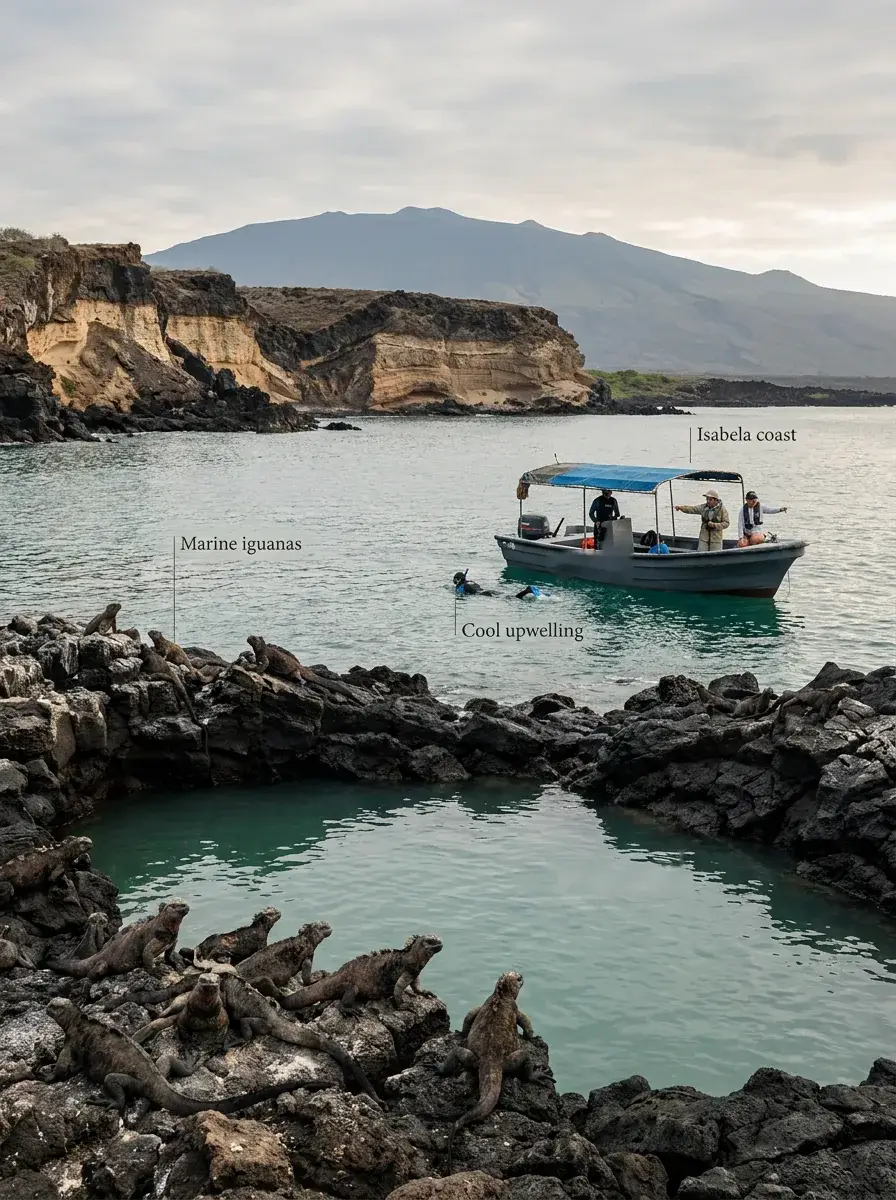
The biggest differences in western Galapagos cruise wildlife come from the cold water. The Cromwell Current rises near the western islands, bringing nutrients and fish that sustain penguins, cormorants and marine mammals.
Species that are easier to see in the west
- Galapagos penguins fishing near Tagus Cove, Punta Vicente Roca and Elizabeth Bay
- Flightless cormorants drying their small wings on the shore
- Marine iguanas feeding on algae, sometimes in large groups underwater
- Galapagos fur seals, sea turtles and, in season, ocean sunfish near the cliffs
- Bryde’s whales, dolphins and occasionally orcas in the Bolivar Channel
Species that are easier in the east
Waved albatrosses on Española (roughly April to December), large frigatebird and booby colonies on Genovesa, and the gentle beaches of the older islands are eastern highlights. Our guide to eastern Galapagos cruise wildlife covers that side in detail, and the eastern vs western Galapagos cruise comparison puts both routes side by side.
Snorkeling and kayaking
Snorkeling in the west is spectacular but colder, often around 19–23 °C (66–73 °F) during the cool season, so a wetsuit is essential. Panga rides along the cliffs are often the best way to see penguins and cormorants. If water time is your priority, read about a snorkeling-focused Galapagos cruise and Galapagos cruises with kayaking.
Hiking on lava
Walks on Fernandina and Isabela cross sharp, uneven lava. They are usually short, but good shoes and a steady pace matter. Ask us which sites suit travelers with limited mobility.
How does trip length change what you can realistically cover?
Distance is the main limit on western Galapagos cruise wildlife. Fernandina and western Isabela lie far from the airports on Baltra and San Cristóbal, so short cruises rarely reach them.
4- and 5-day cruises
Short itineraries usually focus on central islands or on part of Isabela. They can include penguins at some sites, but they rarely include Fernandina and the flightless cormorant colonies.
8-day cruises
An 8-day western loop is the standard way to cover Fernandina, western Isabela and Santiago with enough time at each site. This is the length we recommend for travelers whose top priority is western wildlife.
Combining routes
Some travelers join a western week with an eastern week, either on the same ship or on two different boats, for a complete picture of the islands. It is the best option for photographers and returning visitors. Longer trips need more planning, so read our advice on last minute vs early booking for a Galapagos cruise.
Season and sea conditions
From roughly June to November, the cool garúa season brings stronger upwelling, more active seabirds and rougher seas on open crossings. From December to May, the water is warmer and calmer, though the cold western current still keeps the west cooler than the rest of the islands. If you are sensitive to motion, our guide to the best Galapagos cruise for seasickness helps you choose the right vessel.
Who should choose this route or duration?
The western Galapagos cruise wildlife route suits travelers who want the wildest, most volcanic side of the islands.
Best for
- Wildlife lovers who want penguins and flightless cormorants on their list
- Photographers drawn to lava landscapes, volcanoes and marine iguana colonies
- Confident snorkelers happy to wear a wetsuit in cooler water
- Returning visitors who already know the central and eastern islands
Consider another route if
- You can travel only 4 or 5 days
- Waved albatrosses on Española are a must-see
- You prefer warm water and long beach walks
Private groups can also choose the western route on a charter; see our eastern vs western Galapagos charter guide.
A sample western day
A typical day starts with an early panga ride along the cliffs of Punta Vicente Roca, looking for penguins, sea turtles and fur seals. After breakfast, the group snorkels in cool green water where marine iguanas feed on algae. During lunch the yacht crosses the Bolivar Channel, often with dolphins or whales alongside. In the afternoon, a dry landing at Punta Espinoza on Fernandina leads to lava fields full of marine iguanas and nesting flightless cormorants. That rhythm is what makes western Galapagos cruise wildlife so memorable.
Wildlife etiquette on the western route
Park rules apply everywhere: stay on marked trails, keep at least 2 meters (6 feet) from animals, never touch or feed them, and follow your naturalist guide at all times. Penguins and cormorants nest close to the trails in some places, so calm, quiet movement matters even more in the west.
What to pack for the west
- A good wetsuit, or confirm one is included on your boat
- Sturdy closed shoes for sharp lava and sandals for wet landings
- A warm layer and a light rain jacket for cool, misty mornings
- Reef-safe sunscreen, a hat and a dry bag for panga rides
- Binoculars and a camera with a zoom lens for cliffs and whales
The value of the western route
Standing on fresh lava on Fernandina, watching a penguin swim past a flightless cormorant on the equator, you understand why Galapagos changed how we see evolution. There is no other place like it, and the western route shows that uniqueness at its most raw.
Frequently asked questions about western Galapagos wildlife
Where can I see penguins in the Galapagos?
Mainly on western Isabela and Fernandina, at sites such as Tagus Cove, Punta Vicente Roca, Punta Moreno and Elizabeth Bay. Small groups also live near Bartolomé.
Do all western cruises visit Fernandina?
No. Fernandina is included only on some itineraries, depending on each vessel’s park permit. Always check the day-by-day plan before booking.
How many days do I need for the western islands?
An 8-day itinerary is usually needed to cover Fernandina and western Isabela properly. Shorter cruises rarely reach the far west.
Is the water cold in the western Galapagos?
Yes, it is the coolest part of the islands because of upwelling currents. A wetsuit is recommended year-round and essential from June to November.
When is the best time to see western wildlife?
Wildlife is present all year. June to November brings richer upwelling and very active seabirds, while December to May offers calmer, warmer conditions.
{“@context”:”https://schema.org”,”@type”:”FAQPage”,”mainEntity”:[{“@type”:”Question”,”name”:”Where can I see penguins in the Galapagos?”,”acceptedAnswer”:{“@type”:”Answer”,”text”:”Mainly on western Isabela and Fernandina, at sites such as Tagus Cove, Punta Vicente Roca, Punta Moreno and Elizabeth Bay. Small groups also live near Bartolomé.”}},{“@type”:”Question”,”name”:”Do all western cruises visit Fernandina?”,”acceptedAnswer”:{“@type”:”Answer”,”text”:”No. Fernandina is included only on some itineraries, depending on each vessel’s park permit. Always check the day-by-day plan before booking.”}},{“@type”:”Question”,”name”:”How many days do I need for the western islands?”,”acceptedAnswer”:{“@type”:”Answer”,”text”:”An 8-day itinerary is usually needed to cover Fernandina and western Isabela properly. Shorter cruises rarely reach the far west.”}},{“@type”:”Question”,”name”:”Is the water cold in the western Galapagos?”,”acceptedAnswer”:{“@type”:”Answer”,”text”:”Yes, it is the coolest part of the islands because of upwelling currents. A wetsuit is recommended year-round and essential from June to November.”}},{“@type”:”Question”,”name”:”When is the best time to see western wildlife?”,”acceptedAnswer”:{“@type”:”Answer”,”text”:”Wildlife is present all year. June to November brings richer upwelling and very active seabirds, while December to May offers calmer, warmer conditions.”}}]}
Ready to see penguins and flightless cormorants on the equator? Explore our Galapagos cruises, then email hola@galapagosislands.cruises with your dates and wildlife wishes. We will shortlist only the best boats with the right western permits, explain what to check with each operator and owner, and answer your questions until you sail.
Next step: see Western Galapagos Cruise Itinerary.
Keep planning: related Galapagos guides
 Itineraries & Routes · 4 min readBest Galapagos Cruise Route for Snorkeling: What to Compare
 Itineraries & Routes · 4 min read10-Day Galapagos Itinerary: An 8-Day Cruise Plus Santa Cruz or Isabela
 Itineraries & Routes · 4 min readCan You See Galapagos Penguins on a 5-Day Cruise?
 Wildlife & Activities · 8 min readBest Galapagos Cruise Routes for Penguins: Where the Itinerary Matters
Start from the main guides: Galapagos cruises Galapagos charters Galapagos cruise ships
