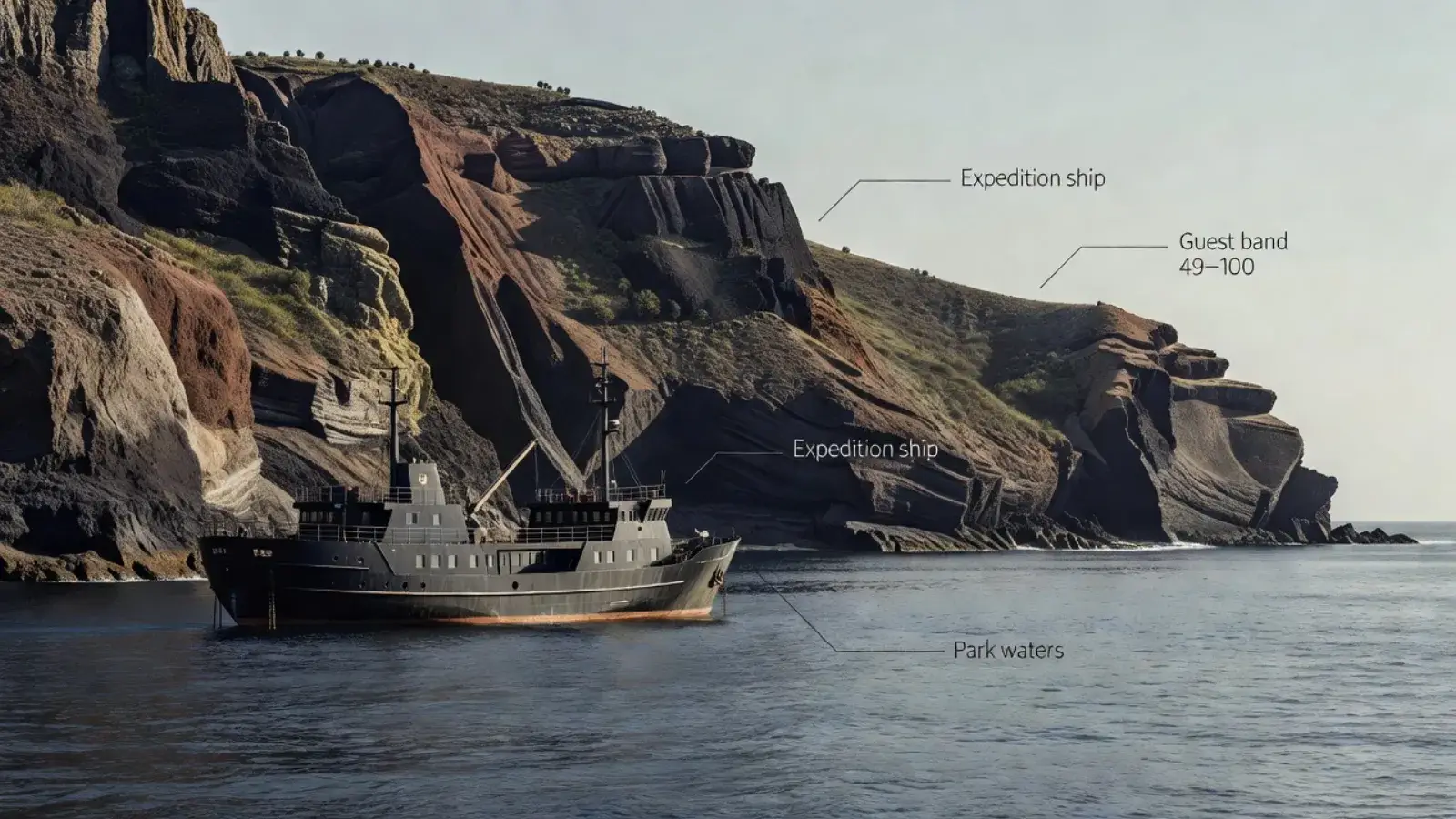
A Galapagos charter for 49 to 100 guests is a full-vessel buyout at larger expedition-ship scale—cabin map, guide ratios, dining flow, and permitted itinerary reality—not a casual headcount bump from a mid-size yacht. At this band you compare larger expedition formats for how forty-nine to about one hundred people actually live aboard under park rules. Read capacity, cabin adjacency, and customization limits before requesting a quote. If you are still weighing ships and routes, our overview of Galapagos cruises helps you narrow it down.
Galapagos charter for 49 to 100 guests: what is the quick answer?
Quick answer: choose a Galapagos charter for 49 to 100 guests when your party can fill (or nearly fill) a vessel in that licensed band and wants private dining control, synchronized landing logistics, and exclusive cabin assignment across a larger expedition footprint. Skip a buyout if your true headcount fits a 30–48 mid-size ship more cleanly, or if you need yacht-level intimacy that only ~16-guest vessels provide.
That is the practical core of a Galapagos charter for 49 to 100 guests. Forty-nine to one hundred is a serious operational band: corporate incentives, alumni waves, and multi-chapter affinity trips live here. A serious large-ship charter conversation therefore starts with published capacity, cabin list, and what cannot be customized under Galapagos operating rules.
Use this rule of thumb
- Choose this band when headcount and cabin demand truly require larger expedition inventory.
- Use this band as a logistics-and-fit compare, not a wildlife scoreboard.
- Verify guide ratios, landing group splits, and dining flow at full occupancy.
- If intimacy matters more than amenity cushion, leave this band and browse smaller charter yachts.
Start with 49 to 100 guests charter, frame size with 30 to 48 guests, then browse yacht charter options.
Who is this private-group setup best for?
Profiles beat slogans when you evaluate a larger private buyout.
Corporate and incentive groups at scale
Teams that need private briefings, shared dining, and predictable cabin inventory for fifty-plus people often fit this band. Confirm whether public spaces absorb the full party without hallway congestion. A Galapagos charter for 49 to 100 guests works when the agenda is expedition-first, not conference-resort.
Large reunions and multi-chapter trips
Multi-household reunions and multi-chapter clubs that outgrow mid-size ships land here. Prioritize cabin adjacency maps and mixed-age pacing. Reunion energy is social; expedition landings still follow park clocks.
Affinity clubs and alumni waves
Alumni or affinity waves that travel as one vessel community may prefer a larger buyout over scattered cabin bookings. Ask how enrichment and optional activities are typically staged at this occupancy. Shared purpose helps; overcrowded pangas do not.
When this band is the wrong fit
If your true party is 20–40 and you want tighter social control without large-ship circulation, a mid-size charter is usually wiser. If you want living-room intimacy, a ~16-guest yacht charter fits better. Place yourselves honestly before forcing this band into the wrong story.
Decision owner and deposit discipline
Large groups fail when five people negotiate cabins. Name one decision owner and a written cabin priority list. That soft factor saves more friction than any sundeck photo for a Galapagos charter for 49 to 100 guests.
How do vessel size, cabins and guide logistics change the decision?
Vessel size, cabin hardware, and guide logistics turn headcount into a workable week.
Capacity band and circulation
Forty-nine to one hundred guests need hallways, dining rooms, and outdoor decks that absorb gear-up moments. Ask how breakfast and briefing flow at full occupancy. Circulation quality is a lived difference at this occupancy.
Cabin inventory shape
Request the full cabin list: twins, doubles, triples if offered, interconnecting options, and which cabins share walls with public rooms. Adjacency maps matter more than brochure suite names. Cabin shape often decides whether a Galapagos charter for 49 to 100 guests feels organized or chaotic.
Guide ratios and landing splits
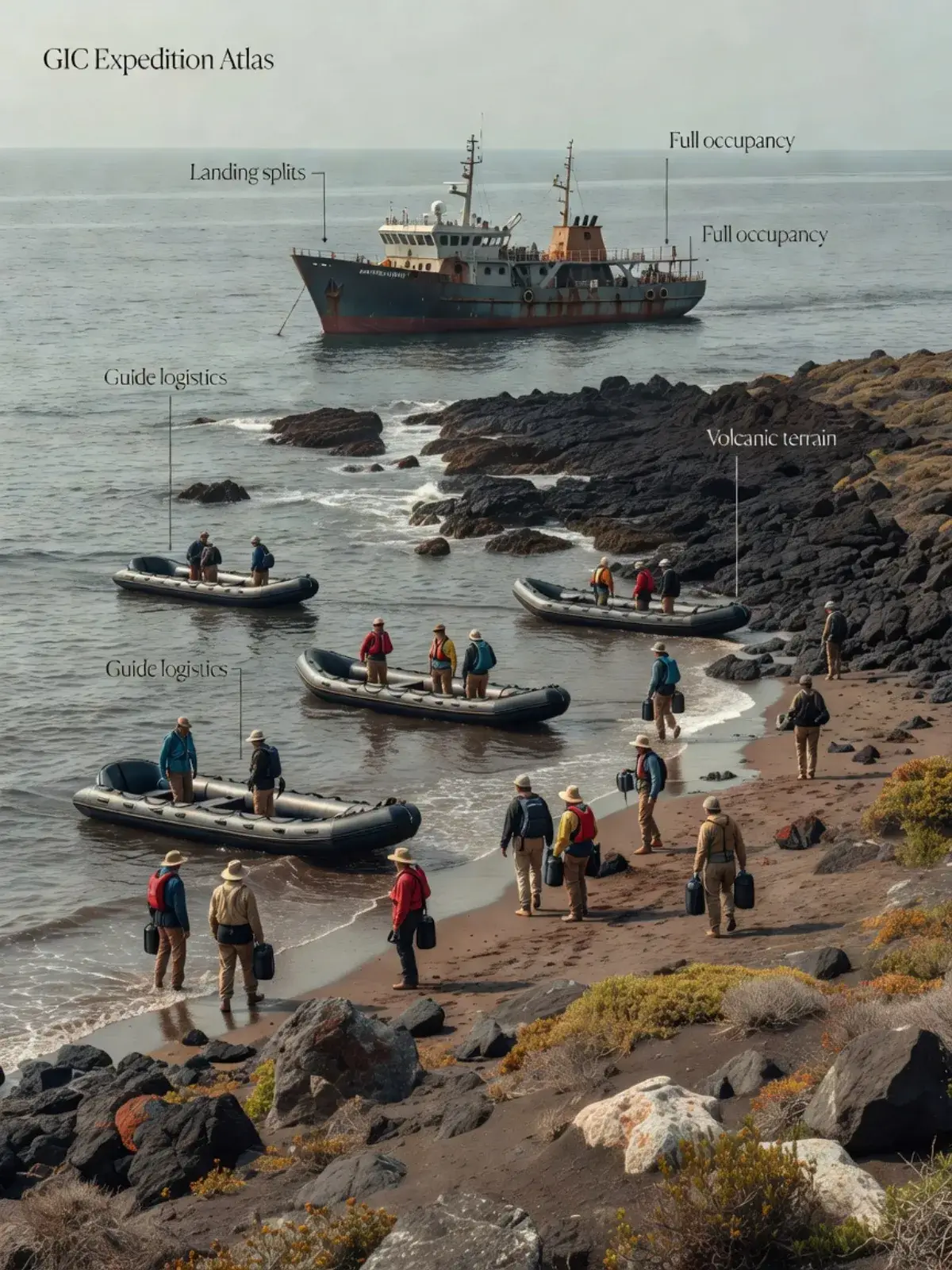
Park rules and vessel permits shape how groups split for landings. Ask how many naturalist guides typically work a full charter and how shore groups are sized. Guide logistics—not marketing language—set the day feel at this occupancy.
Dining and dietary coordination
Private buyouts usually make dietary coordination easier than scattered shared sailings, still inside galley limits. Send dietary lists early. Food rhythm shapes satisfaction after long landings as much as cabin photography.
Motion comfort across the cabin map
Larger expedition hulls can feel steadier than tiny yachts, yet cabin location still matters. Rank lower/mid/upper preferences for sensitive guests. Motion notes belong in the same brief as headcount.
Public-space absorbency at embarkation
Watch how the vessel handles luggage staging, safety briefings, and first-night dinner when nearly full. Larger ships that look spacious in empty photos can feel tight when dozens of people move at once. Ask for a candid description of embarkation flow.
Interconnecting and family-cluster cabins
Large groups often need clusters: grandparents near kids, executives near each other, or quiet corners for early sleepers. Request which cabins can cluster. Cluster planning prevents day-two cabin envy.
Naturalist briefing rooms and enrichment pace
At this occupancy, enrichment works only if seating and acoustics support the full party—or intentional splits. Ask how evening briefings are typically run on a full buyout.
Panga and wet-landing throughput
More guests means more boat rotations unless the operation splits efficiently. Ask for a typical landing timeline at full charter occupancy—not a best-case marketing schedule for a Galapagos charter for 49 to 100 guests.
Insurance, contracts, and cancellation windows
Large-group deposits and name-change rules can be stricter than single-cabin bookings. Align your company’s or family’s payment schedule with the operator’s deadlines. Contract clarity belongs in the same week you fall in love with a sundeck photo for a Galapagos charter for 49 to 100 guests.
Staff-to-guest feel without invented ratios
Ask how many hotel and deck crew typically support a full charter, and how naturalist coverage scales. Exact numbers vary by vessel documentation—request current notes rather than memorizing a blog figure. Staffing feel shows up at gear-up and dinner turns more than in brochure adjectives.
Accessibility and mobility planning at scale
Larger expedition ships may offer elevator access on some decks while landings remain wet and uneven. Confirm cabin-to-deck paths and realistic shore participation for guests with limited mobility. Accessibility honesty prevents day-two disappointment on a Galapagos charter for 49 to 100 guests.
What can and cannot be customized under Galapagos operating rules?
This section prevents large-group disappointment. In an honest Galapagos charter for 49 to 100 guests conversation, “private” does not mean “anything goes.”
What you usually can influence on a charter
- Cabin assignments across the vessel
- Dietary coordination and some meal timing within operational limits
- Emphasis topics with naturalists (habitats, photography pacing, slower walk options)—still inside the permitted day plan
- Celebration touches when the crew can support them
- Which available permitted itinerary week you buy, when inventory allows
What you usually cannot rewrite
- Visitor-site permits and park schedules
- Wildlife guarantees or exclusive “secret” landings outside rules
- Sea-state and weather constraints on pangas and snorkeling
- National park group-size and guide requirements that still apply to charters
Itinerary letters remain letters
You select among offered permitted weeks; you do not invent a private archipelago. If marketing language sounds like custom island-hopping without limits, pull the conversation back. That discipline keeps a Galapagos charter for 49 to 100 guests adult.
Activities stay condition-dependent
Kayak, snorkel, or similar options—when offered—remain tied to conditions and staffing. Confirm what is typically available on the letter you want.
Service culture at scale
Ask how the crew stages fifty-plus people for wet landings without losing the expedition tone. Scale changes pacing even when the site list matches a smaller ship’s brochure week.
Comparing this band to mid-size and yacht options
A 30–48 guest charter feels more mid-size and may suit groups that still want exclusivity without large-ship circulation. A ~16-guest yacht charter maximizes intimacy. Place Galapagos charter for 49 to 100 guests as the larger exclusive option with expedition-ship logistics. Cross-check with 16 vs 100 passenger framing before you stretch the wrong band.
What should the group confirm before asking for a quote?
Confirmation turns enthusiasm into a clean charter brief.
Checklist before quote
- Final headcount range and cabin-type demand (twins/doubles/adjacencies)
- One decision owner and a ranked cabin priority list
- Preferred itinerary themes and acceptable alternate letters
- Month window plus mainland buffer nights for US connections
- Dietary and mobility notes for the full party
- Inclusion boundaries: park fee, Transit Control Card, flights, tips, drinks
- Whether celebration or corporate agenda items need crew support
Questions to ask the planner
Ask: What is the licensed guest capacity and cabin map for this vessel? Ask: How do landings and briefings typically run at full charter occupancy? Ask: Which itinerary letter applies to our dates? Ask: What can and cannot be customized under park rules? Ask: What is included versus fees and flights for a Galapagos charter for 49 to 100 guests?
Booking path
Browse 49 to 100 guests, compare formats via yacht charter, and email hola@galapagosislands.cruises with headcount, cabin needs, and month window. Ready to turn Galapagos charter for 49 to 100 guests into a shortlist? Send a one-page group brief so the quote round stays clean.
Frequently asked questions for “Galapagos charter for 49 to 100 guests”
Is this the same as booking cabins on a shared sailing?
No. A buyout means your group takes the vessel’s guest capacity for that departure. Shared sailings mix parties. Keep that distinction clear for any Galapagos charter for 49 to 100 guests.
Can we customize every landing?
Not beyond permitted itinerary and park rules. You influence cabin life and some onboard rhythm; you do not rewrite the protected-area day plan.
Is a 49–100 guest charter more “exclusive wildlife”?
Exclusivity is social and logistical aboard the ship—not a private park. Habitat access still follows the letter and conditions.
When should we choose a mid-size ship instead?
When your true headcount fits 30–48 more cleanly and you want less circulation complexity. Headcount alone should not force a Galapagos charter for 49 to 100 guests if half the cabins would sit empty awkwardly.
How should US groups decide quickly?
Freeze headcount, cabin map needs, and month window first, then compare two vessels in-band. Email hola@galapagosislands.cruises with that brief so a Galapagos charter for 49 to 100 guests quote stays focused.
Freeze the cabin map and letter before brand ads restart the debate. Ready to plan? Visit 49 to 100 guests and write hola@galapagosislands.cruises when your group numbers are clear.
Keep planning: related Galapagos guides
 Private Charters · 9 min readPrivate Galapagos Charter for a Celebration: Yacht Size, Cabins and Privacy
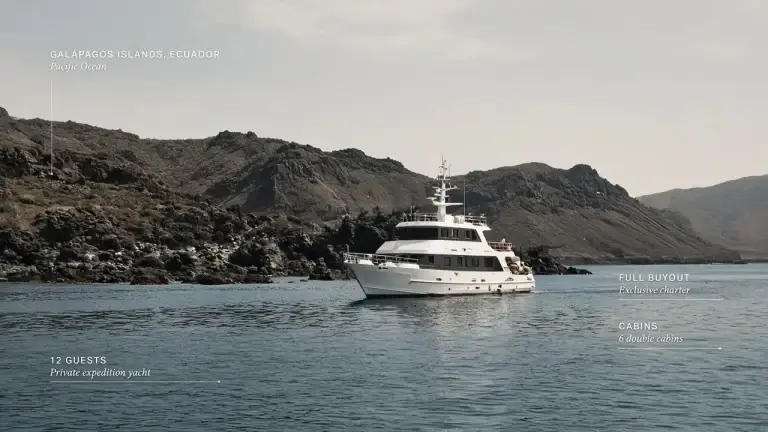 Private Charters · 7 min readPrivate Galapagos Charter for 12 Guests: What Size Boat Makes Sense?
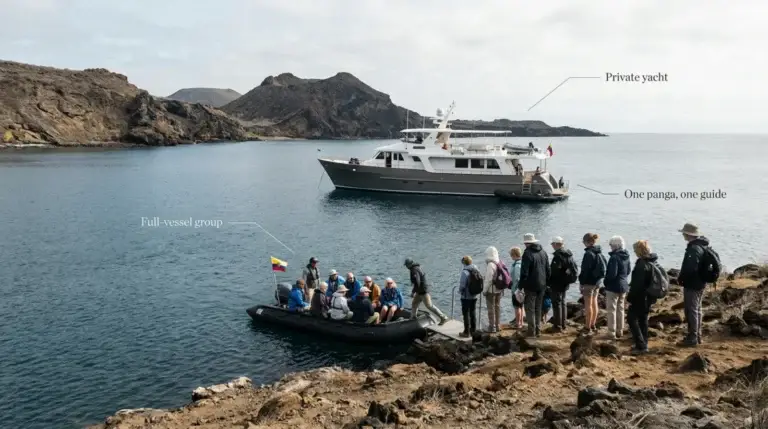 Private Charters · 9 min readWhen Can a Galapagos Charter Cost Less Per Person Than Shared Cabins?
 Private Charters · 8 min readGalapagos Charter Deposits and Cancellation Terms: What to Compare
Start from the main guides: Galapagos cruises Galapagos charters Galapagos cruise ships
